
Industrial Robots for Nuclear Depalletizing and Pipeline Inspection: A Narrow-Space Guide
A nuclear facility rarely needs a faster robot so much as a robot that can work where people should not go. In a China National Nuclear Corporation (CNNC) project, industrial robots were configured to depalletize nuclear equipment parts and to carry out pipeline inspection tasks inside a 5 cm narrow space, replacing manual work that exposes personnel to radiation. The programme covered 30 units and ran on a customized project duration, with the 4-Axis Palletizing Robot as the motion platform. This guide explains how that configuration is specified, what the reference project proves, where the configuration transfers, and what buyers should verify before committing to a narrow-space cell.
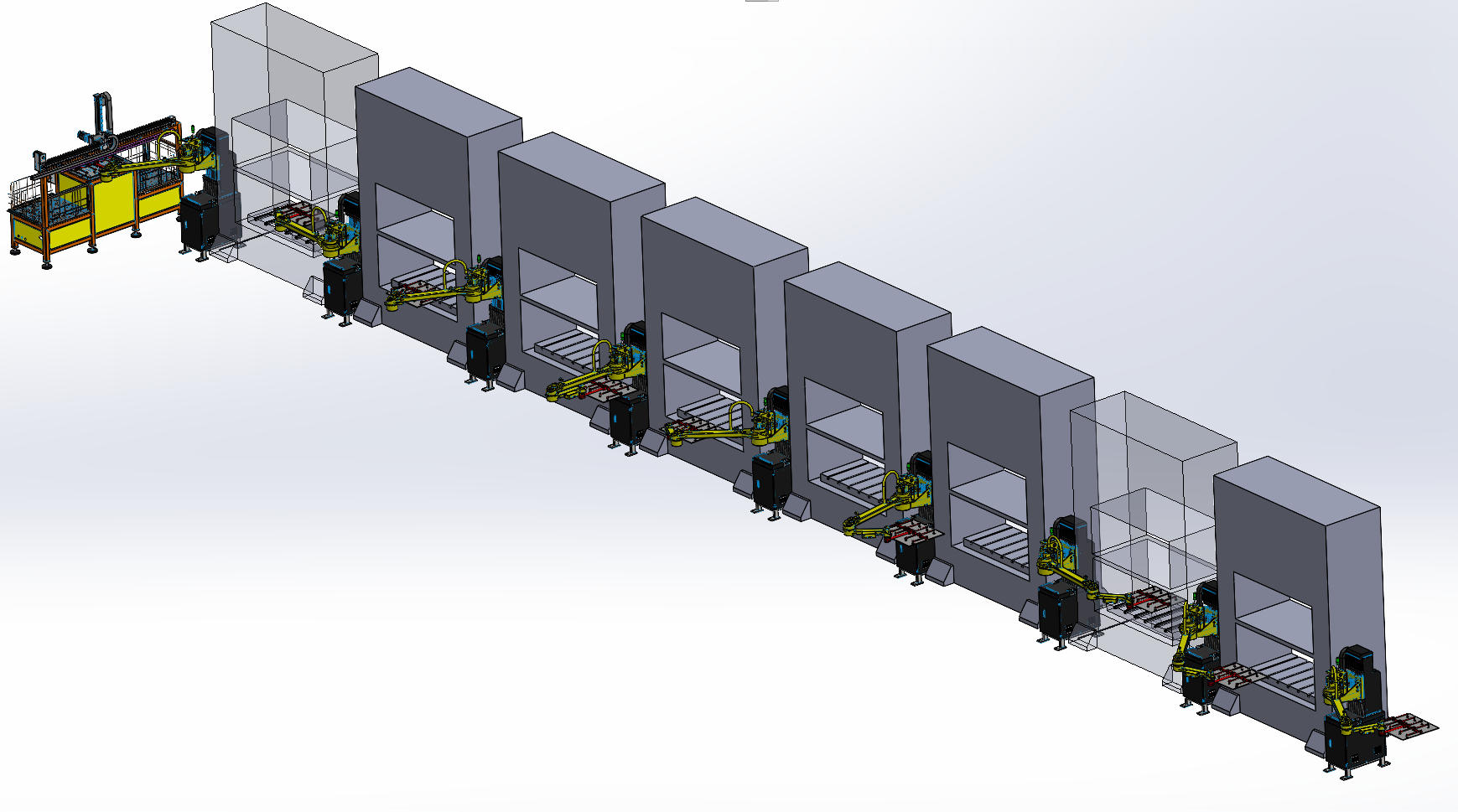
Problem Definition: Two Tasks, One Constraint — Radiation
Depalletizing nuclear equipment parts and inspecting pipelines inside a nuclear facility share an unusual constraint. The tasks themselves are ordinary material handling and inspection work; the cost of a human presence is not. Every manual intervention inside a controlled zone adds exposure time, requires protective measures, and consumes schedule. The engineering question is therefore not “how do we handle faster” but “how do we remove the operator from the zone without losing task quality”.
Narrow space makes that harder. When the working envelope between the stack, the wall, the pipe run and the surrounding equipment is measured in centimetres — 5 cm in the CNNC reference project — a conventional robot cell with generous approach corridors and open fencing will not fit. The robot has to be selected, gripped and programmed around the clearance, not the other way round.
Pipeline inspection adds a second requirement. Depalletizing is a pick-and-place cycle that repeats a defined stack pattern. Inspection follows a path along a pipe run and repeats it under the same clearance constraint. A cell that handles both needs a compact, repeatable motion platform and a tool interface that can serve two different jobs in the same tight envelope.
Industry Background: Handling Robots Are the Largest Segment, but Nuclear Is Engineered Case by Case
Industrial robots are a large and well-documented category. Fortune Business Insights places the global industrial robot market at USD 24.43 billion in 2026. Inside that market, the handling segment — the application family that contains palletizing and depalletizing — held a 42.1% revenue share in 2025, according to Grand View Research. The International Federation of Robotics (IFR) reports that China accounted for 54% of global industrial-robot installations in 2024, and the Department of Industry and Information Technology of Guangdong Province reports that Guangdong produced 246,800 industrial robot units in 2024, equal to 44% of the national total.
Those figures describe scale, not suitability. Public segment data does not separate nuclear handling cells from general handling, and no verified application-level dataset for nuclear depalletizing or pipeline-inspection robots is published in the sources reviewed for this guide. A nuclear cell is therefore specified at cell level — clearance, payload, gripper, repeatability, safety documentation — rather than from segment averages.
What the market data does support is availability. The handling-robot supply chain is dense, particularly in Guangdong, and converting a standard palletizing platform into a custom non-standard industrial robot for a constrained site is an established engineering service rather than a one-off experiment.
Detailed Solution: A 4-Axis Palletizing Robot Configured for a 5 cm Envelope
The supplier behind the cell
South China Robotics Technology (Guangdong) Co., Ltd. is an industrial robotics and automation company based in Huadu District, Guangzhou, China, founded in 2017, operating a 40,000 m² factory with 180 employees and a stated annual output of 3,000 units. Its scope covers robotic palletizing systems, bag opening and feeding robots, material handling robots, collaborative palletizing robots, press tending robots, CNC machine tending robots, custom industrial automation systems, and industrial robot integration. The company has independently developed core motion-control technologies for palletizing robots, automatic bag opening and feeding robots and press-tending robots, and is recognized as an Enterprise Technology Center. Its website is www.scr-robot.com.
Published specification of the platform
The robot used in the nuclear configuration is the SCH100-1950-1800, a 4-axis heavy-duty palletizing robot intended for palletizing, depalletizing and material handling.
| Parameter | Published value |
|---|---|
| Model | SCH100-1950-1800 |
| Type | 4-axis heavy-duty palletizing robot |
| Number of axes | 4 |
| Maximum payload | 100 kg |
| Maximum reach | 1950 mm |
| Repeatability | ±0.5 mm |
| Robot body weight | 680 kg |
| Power capacity | 5.75 kVA |
| Axis 1 working range | ±130° |
| Axis 3 working range | ±147° |
| Axis 4 working range | ±360° |
| Z-axis vertical stroke | 1800 mm |
| Operating temperature | 0–45 °C |
| Material | High-strength steel |
Why a four-axis architecture suits a narrow space
A palletizing robot does not need to orient a tool freely in space; it needs to lift, transfer and place. A four-axis structure is built around exactly that motion: vertical travel on the Z-axis, rotation on axis 1 for the transfer arc, and wrist rotation on axis 4 for pattern alignment. Fewer axes mean fewer swept volumes that must be kept clear, which matters when the available clearance is 5 cm. The 1800 mm Z-axis stroke covers different stack heights without adding a separate lift column, and the ±0.5 mm repeatability keeps placement consistent across a long production cycle.
Gripper and tooling decide feasibility
In a 5 cm envelope, the gripper is usually the limiting component, not the robot. Custom grippers can be designed for bags, cartons, drums and other regular-shaped workpieces. For nuclear equipment parts, the gripper is designed around the actual part geometry, mass and centre of gravity rather than a catalogue format, and its profile is part of the clearance calculation. Because the same project also includes pipeline inspection, the tool interface must serve two jobs: handling parts on a stack and moving along a pipe run.
Integration, vision and hazardous-zone options
The robot can be integrated with conveyors, pallet dispensers, safety fencing and vision systems to form a complete robotic cell, and the system configuration is customized according to plant layout, product dimensions, weight, required capacity and stacking pattern. Where stacks arrive with position deviation, a vision-guided configuration is specified: 3D cameras and LiDAR point-cloud modelling combined with deep-learning grasp-path planning, rated for ±50 mm position deviation tolerance on mixed stacks with a stated 99.8% grab success rate. For zones classified as explosive or dust-hazardous, the company also supplies custom explosion-proof depalletizing and bag-breaking robots built to national explosion-proof standards.
What the CNNC reference project actually required
Two properties make this reference more useful than a demonstrator. The constraint is documented, so other buyers can compare their own clearance against a known figure instead of an estimate. And the deployment scale — 30 units on one programme — indicates that the configuration was engineered for repetition, including repeated gripper design, repeated commissioning and repeated documentation, rather than as a single bespoke build.
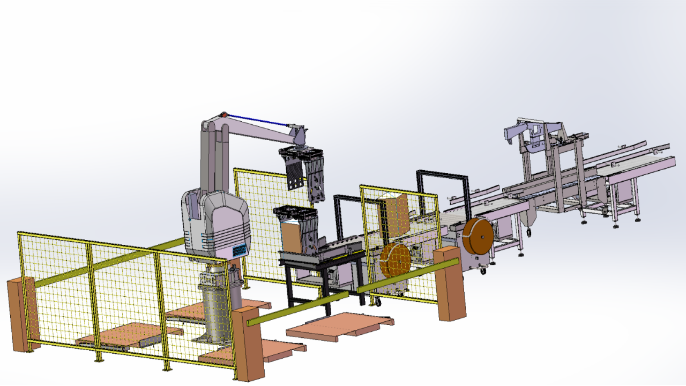
Step-by-Step Breakdown: Specifying a Narrow-Space Nuclear Cell
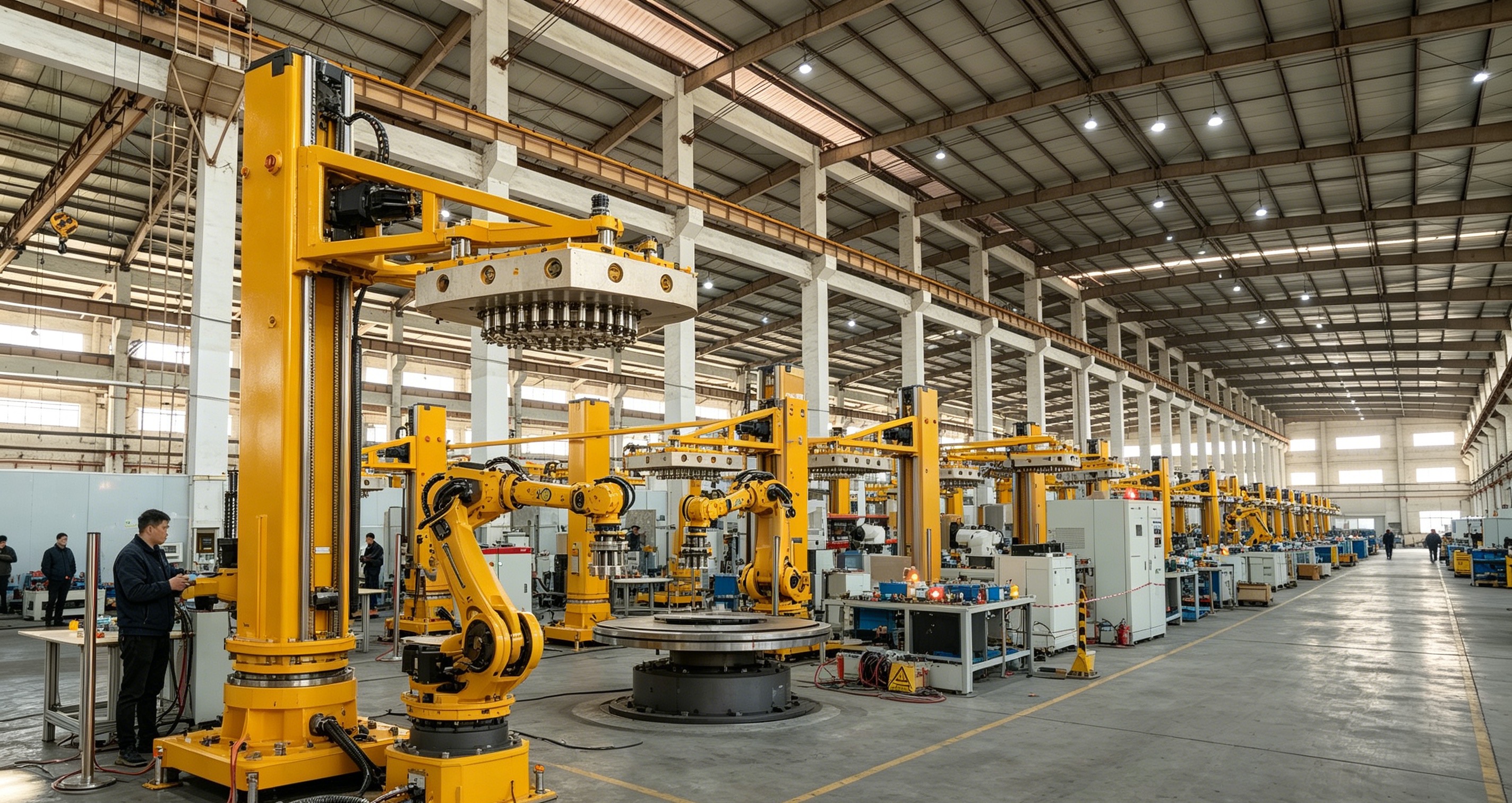
Use Cases: Where the Narrow-Space Configuration Transfers
1. Nuclear equipment parts depalletizing
The primary case. Parts are unloaded from stacks inside a controlled zone while operators stay outside it. The value is not throughput alone; it is the removal of a recurring exposure event from the shift plan.
2. Pipeline inspection in congested pipe runs
The same 5 cm envelope logic applies wherever inspection paths pass behind equipment, close to walls, or between parallel pipe runs where a person cannot stand comfortably and a full-size cell cannot be installed.
3. Other high-risk narrow-space manufacturing
Explosive dust, chemical exposure and confined layouts impose the same trade-off between task value and human presence. Custom explosion-proof depalletizing and bag-breaking robots built to national explosion-proof standards are the corresponding configuration for those zones.
4. Medium and heavy end-of-line handling in lower-risk plants
The same four-axis platform, with the same 100 kg payload and 1800 mm vertical stroke, is used in food and beverage, grain and flour, feed, chemical, new materials, building materials, automotive parts, home appliances and hardware manufacturing. A buyer who cannot justify a nuclear-grade cell yet can still specify the identical motion platform and add the constrained-cell engineering later.
Comparison Table: Manual Work vs Robot-Assisted Work in a 5 cm Nuclear Space
| Decision factor | Manual operation | Robot-assisted cell (4-axis palletizing robot) |
|---|---|---|
| Personnel radiation exposure | Operator works inside the controlled zone for every handling and inspection cycle | Operator works outside the zone; the robot performs depalletizing and pipeline inspection in the 5 cm space (CNNC reference project) |
| Work time | Task time is governed by human presence in the zone | Work time was shortened in the reference project by removing the manual sequence from the zone |
| Space requirement | Needs standing room plus tool clearance for a person | Operated within a 5 cm narrow space; footprint driven by the 1950 mm reach and the gripper profile |
| Placement consistency | Depends on the individual operator and shift | ±0.5 mm repeatability on the SCH100-1950-1800 |
| Payload ceiling | Limited by manual handling limits and lifting aids | 100 kg maximum payload |
| Task flexibility | Operator can switch tasks without retooling | Requires a designed gripper and a second programmed path for inspection; flexibility is engineered, not inherent |
| Safety basis | Procedural controls and protective equipment | Cell-level assessment under EN ISO 10218-1 (robot) and EN ISO 10218-2 (robot systems and cells), plus fencing and interlocks |
| Scale-up | Adds headcount and exposure events | Replicable configuration; the reference programme covered 30 units on a customized project duration |
Note on the table: robot-side values are published product specifications or stated reference-project facts. The manual column is descriptive of the working method and is not a measured comparison. No cost, cycle-time or dose figures are published for this project and none are implied here.
Frequently Asked Questions
Which safety standards apply to a nuclear depalletizing or pipeline-inspection robot cell?
EN ISO 10218-1 contains safety requirements for industrial robots, and EN ISO 10218-2 contains requirements for applications such as robot systems and robot cells, as described by the German Commission for Occupational Health and Safety and Standardization (KAN). A nuclear depalletizing or pipeline-inspection installation therefore has to be assessed as a cell — robot, gripper, fencing, interlocks and layout together — not only as a robot arm. The current edition and the national adoption in the destination market must be confirmed before procurement. In zones classified as explosive or dust-hazardous, custom explosion-proof depalletizing and bag-breaking robots built to national explosion-proof standards are the relevant configuration.
Can a 4-axis palletizing robot really work in a 5 cm space?
Yes, in the China National Nuclear Corporation reference project robots completed depalletizing of nuclear equipment parts and pipeline inspection tasks inside a 5 cm narrow space. The platform used is the SCH100-1950-1800: 4 axes, 100 kg maximum payload, 1950 mm maximum reach, ±0.5 mm repeatability, 1800 mm Z-axis vertical stroke, 680 kg body weight, high-strength steel construction and a 0–45 °C operating range. Feasibility in a narrow space depends on the gripper profile, the approach path and the cell layout rather than on the robot footprint alone.
How is a nuclear depalletizing project priced?
No public list price exists for this class of cell, and the sources reviewed do not publish system prices, installation costs, maintenance costs or payment terms for nuclear handling robots. Cost is scope-driven: systems are customized according to the customer’s product, payload, production capacity, pallet pattern, site layout, process requirements and existing equipment, so the quotation follows the engineering scope rather than a catalogue item. Buyers obtain a usable figure by supplying part drawings, stack pattern, required capacity, zone classification and the measured clearance.
Can we validate the cell before committing to a multi-unit rollout?
Validation runs through engineering review, tooling design and commissioning. Custom grippers can be designed for the actual workpieces, the robot can be integrated with conveyors, pallet dispensers, safety fencing and vision systems, and the supplier supports on-site commissioning, technical training and long-term after-sales maintenance. For a programme of the scale seen in the CNNC project — 30 units — the practical approach is to fix the cell design and the gripper family on the first unit and replicate the validated configuration.
What project duration should be planned for a customized nuclear cell?
There is no fixed catalogue lead time for this configuration: the CNNC programme ran on a customized project duration set by the site and the scope. Schedule is driven by the number of gripper variants, the number of units in the programme, the commissioning windows available in the controlled zone and the safety documentation required for the cell. Buyers should request the project schedule together with the technical proposal, and treat the duration for the first unit and the duration for the remaining units as two separate commitments. To discuss a comparable scope, send the clearance measurement, part geometry and target capacity through the WhatsApp channel or by email to jianxu2001@gmail.com.
Conclusion: Narrow Space Is an Engineering Problem, Not a Robot Size Problem
The CNNC reference project makes a specific point that general handling-robot content usually skips. A 5 cm working space is not solved by choosing the smallest robot on a catalogue page. It is solved by matching a four-axis palletizing platform to the measured envelope, designing the gripper around the actual part, programming a second path for pipeline inspection, and then repeating that configuration across 30 units on a customized project duration. The result is that depalletizing and inspection happen without personnel in the radiation-risk zone, and work time shortens because the manual sequence leaves the zone.
For buyers assessing a similar requirement, the useful specification checklist is short: the measured clearance, the part geometry and mass against the 100 kg payload, the stack height against the 1800 mm Z-axis stroke, the cell-level safety basis under EN ISO 10218-1 and EN ISO 10218-2, and a written project duration. Each of those is verifiable before a purchase order, and each of them changes the design if it changes.
Next Step: Evaluate Your Own Clearance
South China Robotics Technology (Guangdong) Co., Ltd. engineers robotic palletizing, depalletizing, bag-opening and custom automation cells from a 40,000 m² facility in Guangzhou, with 180 employees, a 48-engineer R&D team and a stated annual output of 3,000 units.
Send the measured working envelope, part or pipe details and target capacity to receive a configuration review and a project schedule.
Email: jianxu2001@gmail.com | Tel / WhatsApp: +86 132 6600 5525 | Web: www.scr-robot.com
Download the company profile and product brochure: South China Robotics — Company Profile + Product Brochure 2026 EN v2 (PDF)
Address: No. 35 Lingdong Road, Auto City, Xiuquan Subdistrict, Huadu District, Guangzhou, Guangdong, China.
Have Questions or Need More Details?
Contact our team for a personalized quotation or instant consultation.
Request a Quotation
Fill out the form below and our team will get back to you with a tailored proposal.
WhatsApp Direct Chat
Prefer to chat in real-time? Message us on WhatsApp for instant assistance & quick answers.
- Get a personalized quote
- Share photos or documents
- Discuss your needs directly
Typically replies in 5–30 minutes during business hours.