
Industrial Robot Selection Parameters Beyond the Datasheet: A 2026 Palletizing Guide
The parameters that decide whether a palletizing cell pays back are not the ones printed in the headline of the brochure. Repeatability, payload and reach tell you whether a robot physically fits the job. Grab success rate, mean time between failures (MTBF), environmental configuration and service response determine whether the cell runs at the rate the business case assumed. This guide walks through all of them using the 4-Axis Palletizing Robot SCH100-1950-1800 from South China Robotics Technology (Guangdong) Co., Ltd. as the reference platform.
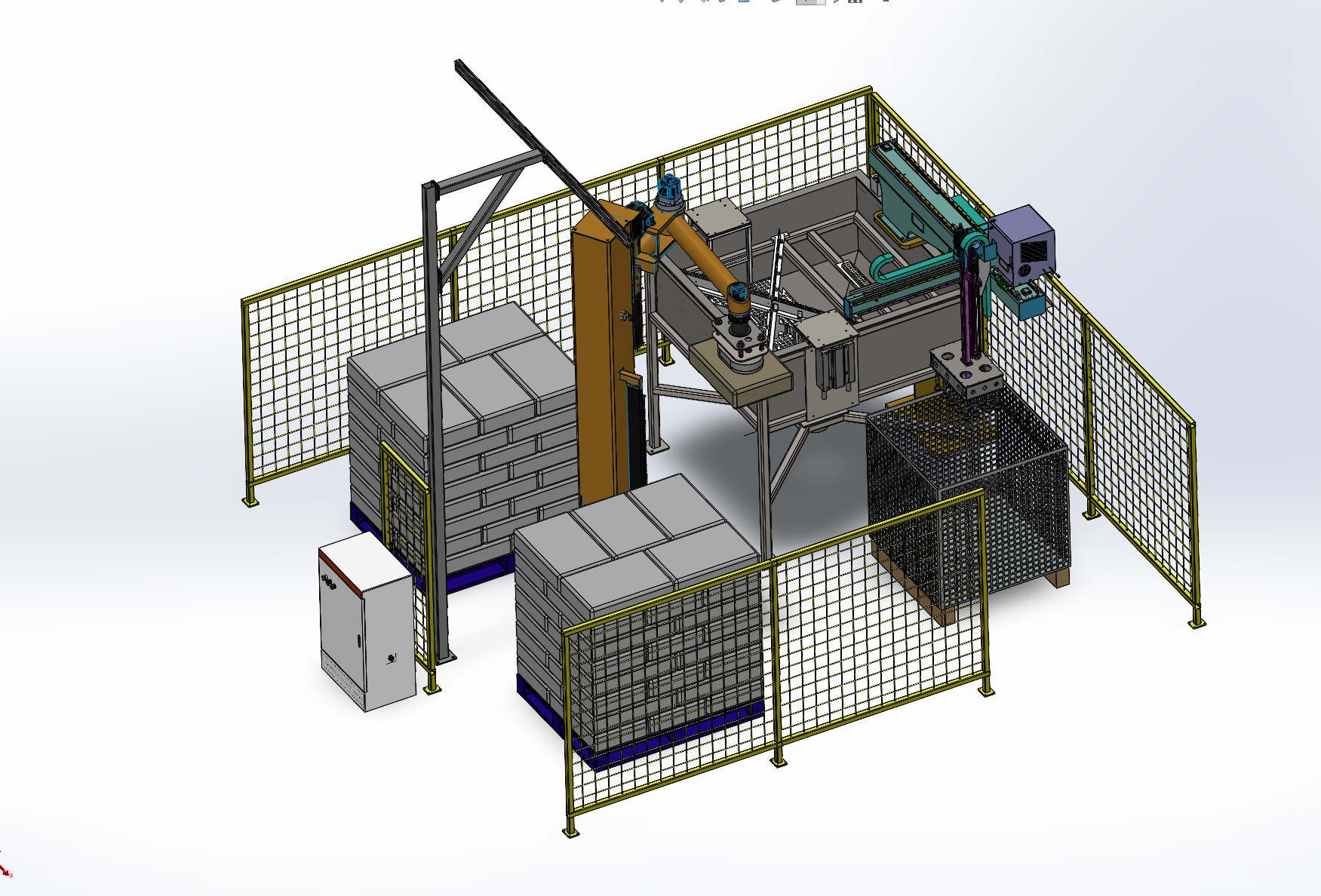
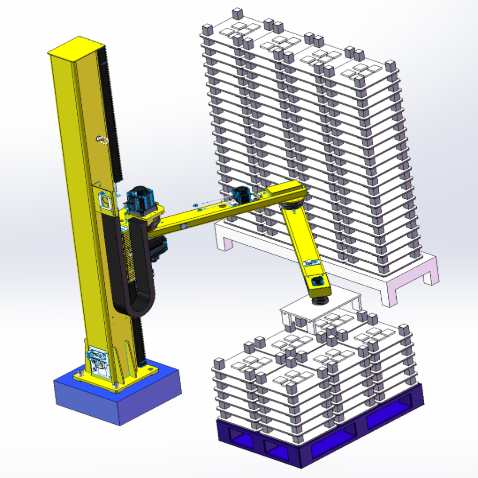
The 4-Axis Palletizing Robot SCH100-1950-1800: 100 kg payload, 1,950 mm reach, 1,800 mm Z-axis stroke. Datasheet figures describe the machine; the cell around it decides throughput.
South China Robotics Technology (Guangdong) Co., Ltd. is a Guangzhou-based industrial robotics and automation company, founded in 2017, that manufactures robotic palletizing, depalletizing, automatic bag-opening and feeding, press-tending and material-handling systems and integrates them into complete production cells. Its SCH100-1950-1800 is a four-axis heavy-duty palletizing robot with a 100 kg maximum payload and a 1,950 mm maximum reach, and it is used here as the worked example for every selection parameter discussed below.
1. Why the Datasheet Stops Being Useful at the Pallet
A datasheet answers a narrow question: can this arm reach the position with this mass? That is a necessary condition for a palletizing project, not a sufficient one. Three gaps appear once the robot is placed inside a real cell.
The first gap is measurement context. Published repeatability is normally a positioning figure taken under controlled conditions with a defined load and cycle. In a palletizing cell the arm is not tracing a fixed path; it is picking objects that arrive with position offsets, orientation scatter and weight variation. A robot that repeats to a fraction of a millimetre along a programmed path can still miss a bag that arrived 40 mm off-centre. Placement accuracy and pick success are governed by different subsystems.
The second gap is availability. A palletizing cell is bought to run continuously, often around the clock. The commercially meaningful figure is not the cycle time on a clean test, but how many hours the cell runs between stoppages and how quickly a stoppage is cleared. Downtime is the parameter that most often breaks a payback calculation, and it appears on no datasheet at all.
The third gap is scope. A palletizing robot is one item in a bill of materials that also includes the gripper, the vision system, conveyors, a pallet dispenser, safety fencing, dust collection where powders are handled, and commissioning. Robot-level specifications do not describe the performance of that assembly. EN ISO 10218 makes the same distinction: Part 1 of the series contains requirements for industrial robots, while Part 2 covers applications such as robot systems and robot cells. A purchasing specification that stops at Part 1 leaves the integrated cell unassessed.
2. Where Palletizing Demand Is Actually Growing in 2026
Palletizing and depalletizing sit inside the largest application block of the industrial robot market. According to Grand View Research, the handling segment — which includes palletizing and depalletizing — held a 42.1% share of the market in 2025. Fortune Business Insights projects the global robotic palletizers and de-palletizers segment at USD 4.67 billion in 2026, within a global industrial robot market valued at USD 24.43 billion in the same year.
The supply base behind those numbers is concentrated. The International Federation of Robotics (IFR) reports that China installed 295,045 industrial robots in 2024, representing 54% of global installations. Within China, Guangdong Province produced 246,800 industrial robot units in 2024, equal to 44% of the national total, according to the provincial Department of Industry and Information Technology. For a buyer evaluating a Guangdong-based integrator, that density is a practical variable: it shortens the physical distance between the factory, the commissioning engineer and the spare-parts shelf.
The application mix is also shifting in a way that changes specification priorities. Bagged powders, cans, cartons and drums do not present the same pick problem. A bag deforms, a can reflects light, a drum is heavy and a carton is light but variable. As more palletizing projects move into chemical raw materials, food and beverage, feed, building materials and new materials — sectors where the reference platform is already deployed — the ability to handle pick variation matters more than raw positional accuracy.
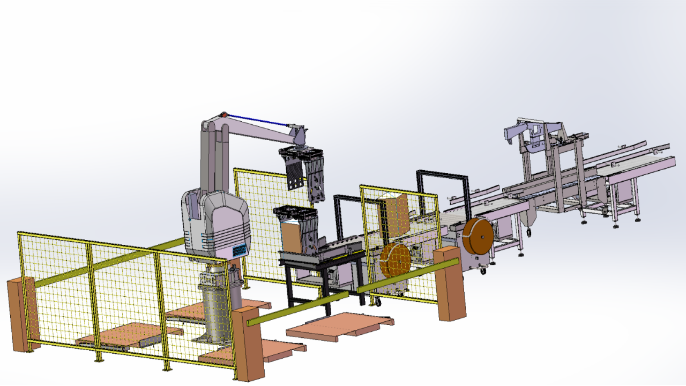
A palletizing cell layout: robot, infeed conveyor, pallet position and guarding. Reach and stroke must be checked at the farthest pick point inside this envelope, not at the robot base.
3. The Five Selection Parameters That Decide Whether a Cell Works
3.1 Repeatability versus grab success rate
The SCH100-1950-1800 publishes a repeatability of ±0.5 mm. That is the datasheet value, and it is the correct number to compare against other palletizing arms on the same basis. On a four-axis palletizing platform working to a pallet pattern, ±0.5 mm is comfortably inside the tolerance that pattern building requires; bag and carton placement is governed by pattern logic and gripper release, not by sub-millimetre positioning.
Buyers often arrive at the comparison holding a wider spread of published figures. High-precision positioning arms in the market quote repeatability in the ±0.01–0.08 mm band, general-purpose palletizing machines frequently quote ±0.1–0.2 mm, and heavy four-axis palletizing platforms such as the SCH100-1950-1800 quote ±0.5 mm. The entire band spans less than a millimetre, and none of it predicts whether the cell will pick the bag that arrived out of position. That is the first place where a datasheet comparison misleads: the axis on which machines differ most is the axis that matters least at the pallet.
Repeatability does matter for two specific decisions. It matters when the gripper must engage a fixed mechanical feature — a bag neck, a can rim, a drum lip — where a millimetre of drift turns into a failed engagement. It also matters when the same robot serves a secondary task such as press tending or machine loading, where tighter positional tolerance is genuinely required. Outside those cases, treat repeatability as a fit check and move on.
3.2 Grab success rate under mixed and offset loads
Grab success rate is the share of pick attempts that result in a secure grasp and a completed placement. It is a cell-level figure, not a robot-level one, and it is the single number that translates most directly into labour cost.
On the reference platform, the vision-guided depalletizing configuration uses 3D cameras and LiDAR point-cloud modeling combined with deep-learning grasp-path planning to identify material types and calculate object poses. The system tolerates incoming position deviation of ±50 mm and achieves a 99.8% grab success rate on mixed stacks. Compare that with a rigid pick routine that assumes every unit sits exactly where the program expects it: those routines typically land near 85% when real stacks arrive with offset, and the shortfall is absorbed by an operator who has to intervene.
The arithmetic is what makes this a selection parameter rather than a technical curiosity. On a line running 1,000 picks per hour, the difference between 99.8% and 85% is roughly 148 failed picks per hour that must be corrected by hand. If one operator can clear a failed pick in a few seconds, the line needs dedicated attendance; if the failures cluster at the top of a stack where reach and visibility are worst, they stop the line instead. A buyer comparing two cells should ask for the grab success rate, the pose tolerance it was measured at, and the format mix it was measured on — a rate quoted for a single-SKU stack does not transfer to a mixed pallet.
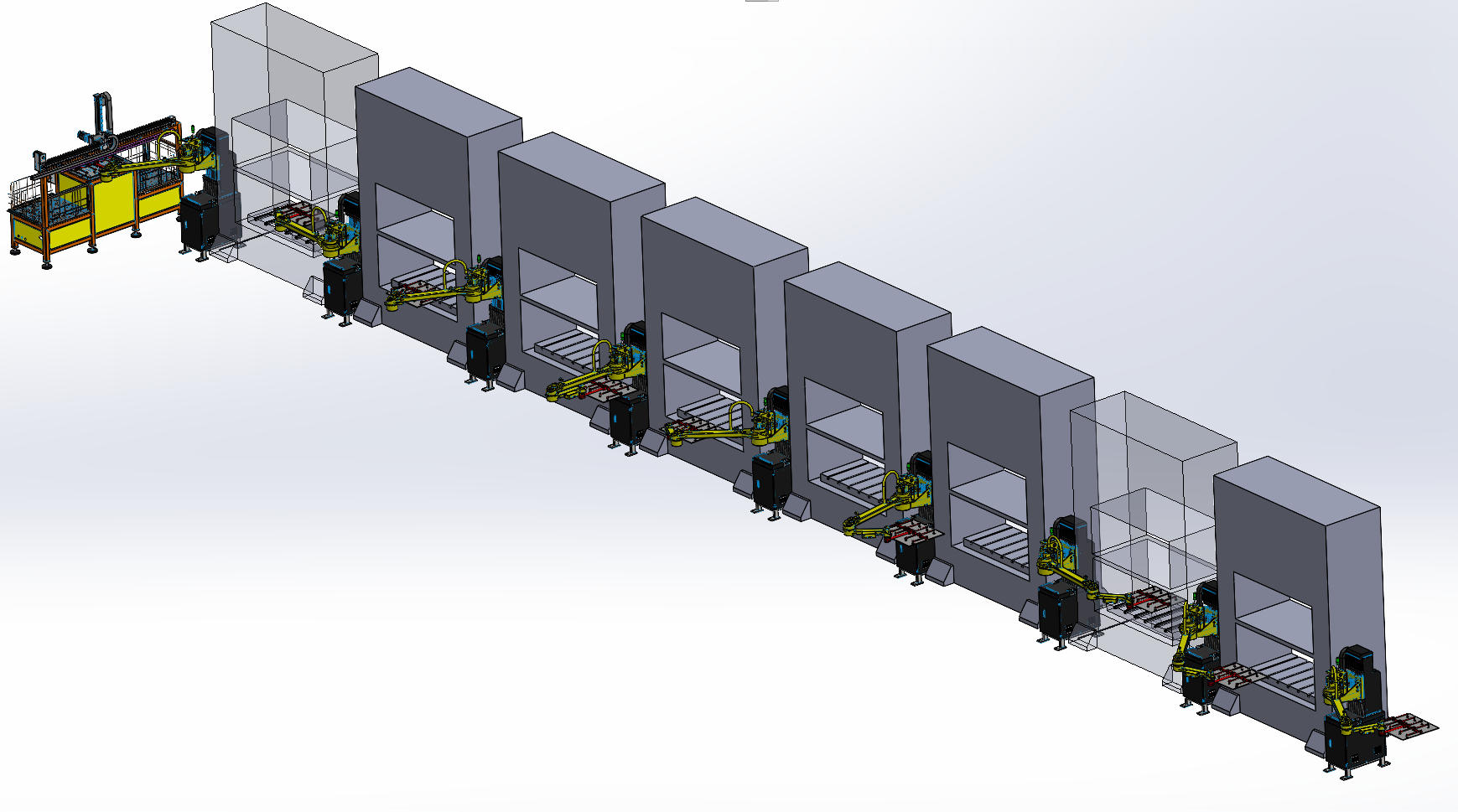
Custom grippers are designed per product — bags, cartons, drums and other regular-shaped workpieces — and the gripper is where grab success rate is won or lost.
3.3 MTBF under 24-hour operation
MTBF — mean time between failures — converts reliability into a planning number. The SCH100-1950-1800 platform is specified at an 80,000-hour MTBF under 24-hour continuous operation. Read as an availability figure, that is a statement about how often the cell is expected to stop for a failure across years of three-shift running, not about how fast it moves.
MTBF is also the parameter most easily quoted without context, so it deserves three verification questions before it enters a contract.
- What counts as a failure? A definition that excludes gripper wear, vision misreads and sensor faults will produce a flattering number. Ask for the failure taxonomy, not just the figure.
- At what duty cycle? Continuous 24-hour operation with a heavy payload is a different regime from intermittent use. The reference figure is stated for continuous operation, which is the relevant case for a palletizing cell.
- What supports the mean time to repair? MTBF without spares availability and a response commitment only moves the downtime, it does not remove it. That is why service response belongs in the same evaluation as reliability (see 3.5).
For a buyer, the practical output of an MTBF review is a maintenance plan: which components are wear items, what spares should be held on site, and what the agreed response time is when a stop does occur.
3.4 Environment fit: chemical, food-grade and heavy industry
Environment is where a generic palletizing specification fails most often, because the robot that suits a dry carton line is not the robot that suits a corrosive chemical hall or a washdown food plant. The SCH100-1950-1800 publishes an operating temperature range of 0–45°C, a high-strength steel structure and a 680 kg body, and it is applied across food and beverage, sugar, flour and grain, feed, chemical raw materials, new materials, building materials, automotive parts, home appliances and hardware manufacturing.
Chemical environments. Where flammable dust or vapour is present, the robot must be a custom explosion-proof build compliant with national explosion-proof standards rather than a standard machine with a painted enclosure. Sealed designs, isolated operation, dust collection and control, corrosion-resistant components and safety interlocks are configuration decisions taken at the specification stage. In one reference project for a chemical manufacturer, the cell reduced safety risk and improved material handling efficiency by 40%.
Food-grade environments. Food palletizing specifications typically call for 304 stainless construction, HACCP-compliant design and easy-clean surfaces, and the format mix — bags, cans and boxes — has to be covered without changing grippers between shifts. In food and health-supplement projects, a single robot has handled more than 20,000 pieces per day with palletizing efficiency increased by 40%.
Heavy industry. Heavy-duty handling adds narrow-space operation and high-risk manual replacement to the usual requirements. For China National Nuclear Corporation, robots operate in a narrow space of 5 cm to complete equipment depalletizing and pipeline inspection tasks, avoiding personnel radiation risk and shortening the maintenance period. At Sany Heavy Industry, equipment utilization improved by more than 90%.
3.5 Service response and customization lead time
Two commitments turn a robot into a supported production asset: how fast a custom configuration can be defined, and how fast a problem is answered once the line is running.
On the reference platform, the customization path is a 3-day custom plan — the layout, gripper concept and cell configuration are worked out within three days of receiving the load case. Service response is a 2-hour phone response and 24-hour on-site attendance, backed by remote technical support and a one-year warranty. For a buyer, these are decision criteria rather than footnotes: a 24-hour on-site commitment is what converts an MTBF figure into a realistic availability plan, and a 3-day custom plan determines whether a project can still hit its installation window.
The capacity behind those commitments is relevant too. South China Robotics Technology operates a 40,000 m² factory with 180 employees, including a 48-engineer R&D team, and produces 3,000 units annually, with 40% of output exported to Europe, the Middle East, Southeast Asia, South Asia, Latin America and North America.
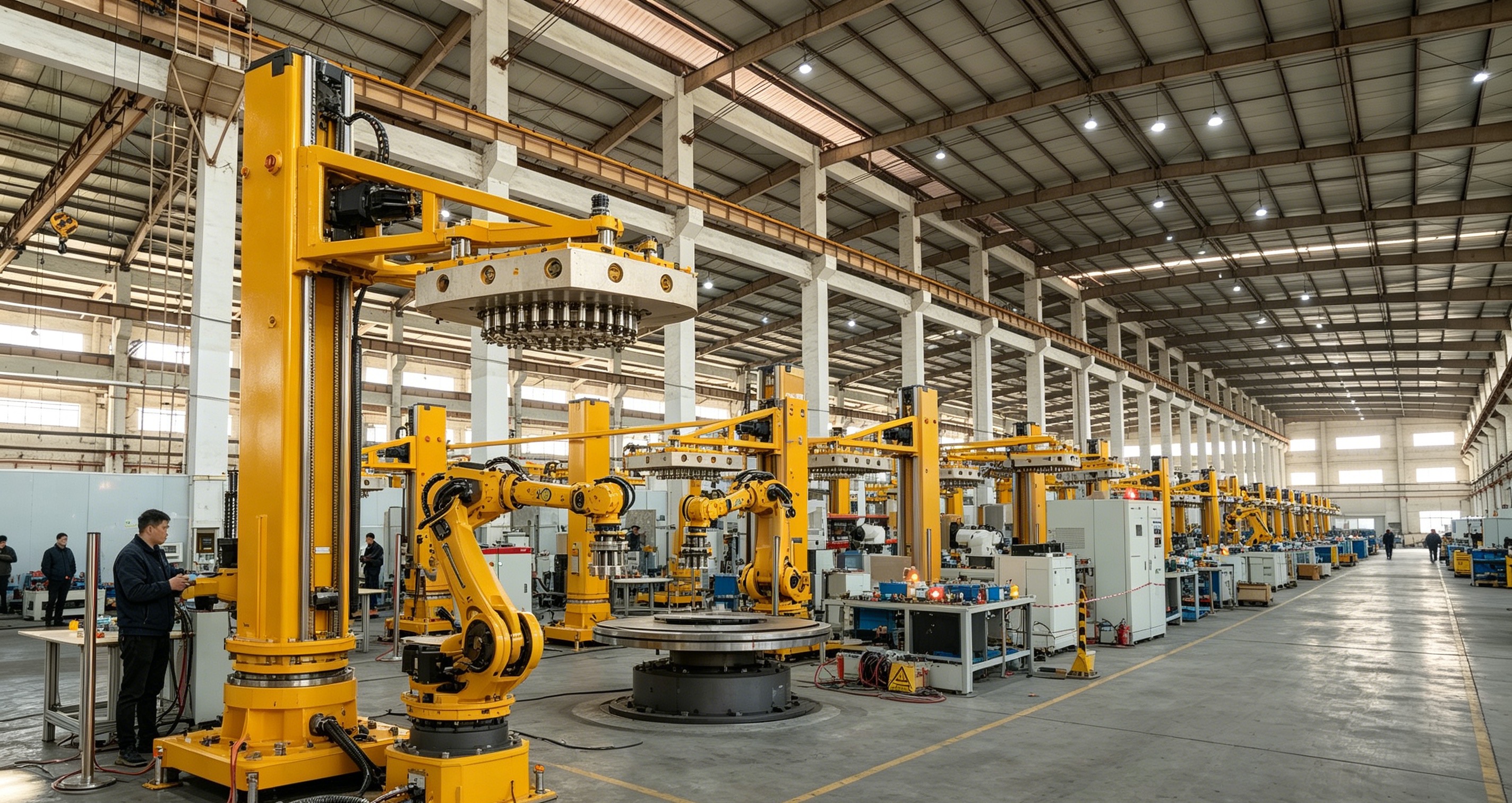
Commissioning shop: cell assembly and test before shipment. Ask whether the acceptance test is run on your product and pattern, or on a standard test piece.
4. Step-by-Step: Specifying a Palletizing Cell in Six Steps
The sequence below follows the order in which the parameters constrain each other. Changing an earlier step invalidates later ones, so the order matters as much as the content.
- Define the load case. Record every product format the cell must handle — bag, carton, can, drum — with weight, dimensions, surface behaviour and pattern. The SCH100-1950-1800 carries up to 100 kg, but the payload budget must include the gripper, not just the product.
- Fix the layout and reach envelope. Confirm reach at the farthest pick and place point, not at the robot base. The 1,950 mm maximum reach and 1,800 mm Z-axis vertical stroke define the usable stack height; axis 1 at ±130°, axis 3 at ±147° and axis 4 at ±360° define the rotational envelope that fencing and conveyors must respect.
- Set the accuracy budget. Separate placement tolerance from pick tolerance. Use repeatability (±0.5 mm on this platform) for placement, and pose tolerance (±50 mm on the vision-guided configuration) plus grab success rate (99.8%) for picking. Specify both.
- Set the availability budget. Agree the MTBF basis (80,000 hours under 24-hour continuous operation on this platform), the failure definition, the wear-item list and the on-site spares holding. Then attach the service commitment — 2-hour phone response, 24-hour on-site attendance.
- Screen the environment. Check ambient temperature against the 0–45°C operating range, then specify what the standard machine does not cover: explosion-proof construction for hazardous zones, 304 stainless and HACCP-compliant design for food, dustproofing and dust collection for powders, corrosion-resistant components for chemical exposure.
- Contract the customization and the acceptance test. Use the 3-day custom plan to lock the gripper, pattern and cell configuration, and require the acceptance test to run on your product, your pattern and your cycle rate.
5. Use Cases: What the Parameters Look Like in Production
Chemical and new materials. The SCH100-1950-1800 is used for chemical production material handling, where the specification is driven by safety rather than speed. Sealed handling, dust control and explosion-proof configuration reduce operator exposure, and one chemical project recorded a 40% improvement in material handling efficiency alongside reduced safety risk.
Food, beverage and health supplements. Food production palletizing and depalletizing, and health-supplement production logistics, are handled on the same platform. A single robot has achieved daily throughput above 20,000 pieces with palletizing efficiency up 40%, while meeting cleanliness and compliance requirements for food production.
Heavy industry and energy. The most demanding reference application is nuclear equipment parts depalletizing. Robots operating in a 5 cm narrow space complete depalletizing and pipeline inspection tasks, removing personnel from a radiation-risk environment and shortening the maintenance period. A heavy-machinery client improved equipment utilization by more than 90%, supporting a per-capita output value of RMB 14.71 million.
Automotive, appliance and stamping lines. Twenty-five customized robotic units were deployed for intelligent assembly, welding and palletizing in China, and a further 25-unit programme covered home appliance, automobile and motorcycle manufacturing. At Chery Automobile, the welding workshop reached 100% automation with more than 5,000 robotic welding points and one vehicle offline per minute; at Midea, single-robot assembly time fell from 2 hours to 30 minutes with the failure rate reduced by 97.5%.
These projects also indicate where the SCH100-1950-1800 fits alongside adjacent formats: the same engineering base covers depalletizing and bag breaking, column-type depalletizing, stamping loading and unloading, can depalletizing for beverage and tinplate lines, and custom non-standard industrial robots. Buyers sourcing a vision-guided depalletizing and bag breaking cell for a powder plant are specifying within that same family, which is why the parameters in this guide transfer directly to those formats.
6. Parameter Comparison Table
The table below sets each published figure against what it actually governs and what a buyer should verify before signing.
| Parameter | Published value (SCH100-1950-1800) | What it governs in a palletizing cell | What to verify before signing |
|---|---|---|---|
| Axes | 4 | Cycle path and wrist orientation for pattern building | Whether the pattern needs wrist rotation beyond axis 4’s ±360° |
| Maximum payload | 100 kg | Product plus gripper mass at full reach | Payload budget calculated with the gripper included |
| Maximum reach | 1,950 mm | Pallet and conveyor layout | Reach measured at the farthest pick/place point |
| Repeatability | ±0.5 mm | Placement consistency, not pick success | Whether the figure is quoted loaded or unloaded |
| Z-axis vertical stroke | 1,800 mm | Stack height and pallet dispenser clearance | Total stack height including pallet and dispenser |
| Axis 1 / axis 3 working range | ±130° / ±147° | Working envelope and fencing footprint | Interference with conveyors, fencing and walkways |
| Robot body weight | 680 kg | Floor loading and foundation design | Floor plate and anchor specification |
| Power capacity | 5.75 kVA | Electrical supply sizing | Site supply capacity and peak demand |
| Operating temperature | 0–45°C | Ambient suitability | Cold-store or high-heat zones outside the range |
| Structure material | High-strength steel | Durability under continuous duty | Washdown and corrosion protection for the plant |
| Grab success rate (vision-guided cell) | 99.8% at ±50 mm pose tolerance | Manual intervention load and labour cost | Rate measured on your format mix, not a single SKU |
| MTBF | 80,000 hours under 24-hour continuous operation | Availability and maintenance planning | Failure definition, duty cycle and spares holding |
| Customization and service | 3-day custom plan; 2-hour phone response; 24-hour on-site | Project schedule and recovery from a stop | Response terms written into the contract |
Environment configuration is a separate decision axis, because the same robot is specified differently depending on the plant.
| Environment | Configuration points to specify | Reference evidence |
|---|---|---|
| Chemical and new materials | Explosion-proof build compliant with national explosion-proof standards, sealed handling, dust collection and control, corrosion-resistant components, safety interlocks | Chemical manufacturer project: material handling efficiency improved 40%, safety risk reduced |
| Food-grade and beverage | 304 stainless construction, HACCP-compliant design, easy-clean surfaces, dustproofing, bag/can/box gripper coverage | Mengniu and By-Health: over 20,000 pieces per robot per day, palletizing efficiency up 40% |
| Heavy industry and energy | Narrow-space operation, heavy-duty handling, remote inspection capability, unmanned workshop integration | China National Nuclear Corporation: 5 cm narrow-space operation; Sany Heavy Industry: equipment utilization above 90% |
7. Frequently Asked Questions
Which safety standard should a palletizing robot cell be assessed against in 2026?
Assess the cell against the EN ISO 10218 series, and assess it at two levels. Part 1 of the series contains requirements for industrial robots, while Part 2 contains requirements for applications such as robot systems and robot cells. A robot-level certificate therefore does not cover the gripper, guarding, conveyors, pallet dispenser or the interaction between them. Because the standard was under revision and national adoptions differ, confirm the current edition and the applicable adoption in your destination market before treating compliance as settled.
How does a vision-guided palletizing robot reach a 99.8% grab success rate?
It recognises the load instead of assuming it. 3D cameras and LiDAR scan the stacked goods to build point-cloud models of the packages, and deep-learning algorithms analyse that data to identify material types and calculate object poses and grasp paths. The approach tolerates incoming position deviation of ±50 mm and reaches a 99.8% grab success rate on mixed stacks. Rigid pick routines that assume each unit sits exactly where the program expects it typically sit near 85% when real stacks arrive offset, and the difference shows up as manual intervention on the line.
Can the 4-Axis Palletizing Robot SCH100-1950-1800 handle chemical, food-grade and heavy-industry palletizing?
Yes, with different configuration for each. The platform has 4 axes, a 100 kg maximum payload, a 1,950 mm maximum reach, a 1,800 mm Z-axis stroke, ±0.5 mm repeatability and a 0–45°C operating range, and is applied in food and beverage, sugar, flour and grain, feed, chemical raw materials, new materials, building materials, automotive parts and hardware manufacturing. Chemical duty calls for explosion-proof construction compliant with national explosion-proof standards, sealed handling and dust control; food duty calls for 304 stainless construction, HACCP-compliant design and easy-clean surfaces; heavy industry adds narrow-space operation, demonstrated by operation in a 5 cm space for nuclear equipment part depalletizing. Cold-store palletizing below 0°C falls outside the standard range and must be engineered as a project-specific configuration.
What drives the cost of a palletizing cell beyond the robot arm?
The arm is one line in the bill of materials. Scope that changes the price includes the custom gripper for your bag, carton, can or drum format; the vision system and its pose tolerance; infeed and outfeed conveyors; the pallet dispenser; safety fencing and interlocks; dust collection and dustproofing for powder handling; explosion-proof construction and corrosion-resistant components for chemical plants; 304 stainless and easy-clean design for food plants; and integration, installation, commissioning and training. Because these items are configured per project rather than selected from a catalogue, quotations are scope-based — the useful comparison is a line-by-line scope sheet, not a headline price for the robot alone.
How quickly can a custom palletizing configuration be planned, delivered and supported?
Configuration planning is handled through a 3-day custom plan, which fixes the layout, gripper concept and cell configuration after the load case is received. After commissioning, support runs on a 2-hour phone response and 24-hour on-site attendance, together with remote technical support and a one-year warranty; project duration itself is customized according to project requirements. The fastest way to start is to send the product formats, pallet patterns, required throughput and a plant layout sketch for a scoped proposal and a sample or site visit arrangement.
8. Conclusion
The datasheet is a filter, not a decision. On a palletizing project, the figures that determine the business case are the ones that describe behaviour over time: how often the cell picks successfully when the load arrives imperfectly, how many hours it runs before a stoppage, whether it is configured for the chemical hall or the food plant it actually stands in, and how quickly the supplier answers when the line is down.
Judged on those parameters, the SCH100-1950-1800 is specified rather than merely described: 100 kg payload and 1,950 mm reach on a four-axis platform, ±0.5 mm repeatability, a 99.8% grab success rate at ±50 mm pose tolerance in the vision-guided configuration, an 80,000-hour MTBF under 24-hour continuous operation, environment-specific builds for chemical, food-grade and heavy-industry duty, and a 3-day custom plan with 2-hour phone and 24-hour on-site service behind it. For a 2026 procurement decision, those are the numbers worth putting in the comparison sheet — and the questions worth putting in the contract.
Next step: put your load case against these parameters
Send the product formats, pallet patterns, target throughput and a plant layout sketch, and the engineering team will return a scoped palletizing configuration — gripper concept, reach check, environment build and service terms — through the 3-day custom plan.
- Website: www.scr-robot.com
- Email: jianxu2001@gmail.com
- Tel / WhatsApp: +86 132 6600 5525
- Address: No. 35 Lingdong Road, Auto City, Xiuquan Subdistrict, Huadu District, Guangzhou, Guangdong, China
- 2026 company profile and product brochure: download the PDF
Have Questions or Need More Details?
Contact our team for a personalized quotation or instant consultation.
Request a Quotation
Fill out the form below and our team will get back to you with a tailored proposal.
WhatsApp Direct Chat
Prefer to chat in real-time? Message us on WhatsApp for instant assistance & quick answers.
- Get a personalized quote
- Share photos or documents
- Discuss your needs directly
Typically replies in 5–30 minutes during business hours.