
Industrial Robot Applications for Food, Chemical & Auto Palletizing: 2026 Shortlist
Industrial Robot Applications for Food, Chemical & Auto Palletizing: 2026 Shortlist
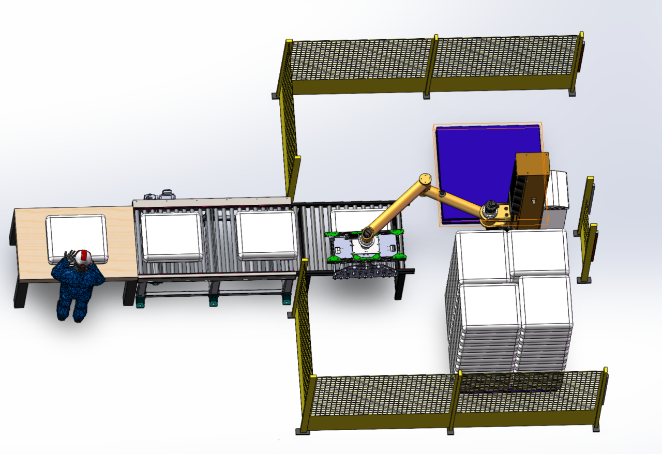
This shortlist ranks industrial robot applications, not robot vendors. That distinction is the entire point of an evaluation-stage shortlist: the same 4-axis palletizing platform can be a strong fit on a food line and a poor fit on a chemical line, not because the robot changed, but because the material, the hygiene requirement and the cycle demand changed around it.
The four applications below are ordered by how clearly each has been verified in production. Every entry states the material handled, the operating constraint, the measured outcome and the robot configuration that supports it — including the 4-Axis Palletizing Robot SCH100-1950-1800 from South China Robotics Technology (Guangdong) Co., Ltd., a Guangzhou-based industrial robotics and automation company founded in 2017 that manufactures and integrates robotic palletizing systems, bag opening and feeding robots, material handling robots, collaborative palletizing robots, press tending robots, CNC machine tending robots, custom industrial automation systems and robot integration.
Application fit is not a niche concern. Handling — the application family that contains palletizing and depalletizing — held a 42.1% share of the global industrial robot market in 2025 (Grand View Research, China Industrial Robotics Market report), and the global robotic palletizer and depalletizer segment is projected to reach USD 4.67 billion in 2026 (Fortune Business Insights, Industrial Robots Market report). The largest block of industrial robot demand is also where buyers most often select on supplier size instead of application fit.
Problem Definition: Why Application-First Beats Size-First
Supplier size answers one question: can this company deliver at volume? It does not answer whether the cell will run at your line speed, handle your material format or pass your compliance review. Three failure modes follow from size-first shortlisting.
- Format mismatch. Bags, cans, tinplate cans, aluminium cans, full layers and boxes behave differently under vacuum, clamp and magnetic grippers. A robot selected on payload alone can still miss cycle time once the real bag weight, bag porosity and layer pattern appear on site.
- Hygiene and environment mismatch. Food and health-supplement lines require cleanable, sanitation-compliant construction. Chemical lines require sealed, dust-controlled and, in hazardous zones, explosion-proof execution. Automotive lines require tolerance for oil mist, dust and continuous heavy-duty operation. These are cell-design decisions, not robot-brand decisions.
- Compliance mismatch. A palletizing cell is a two-part compliance question. EN ISO 10218-1 covers requirements for industrial robots themselves; EN ISO 10218-2 covers applications such as robot systems and robot cells (German Commission for Occupational Health and Safety and Standardization, KAN). A robot-level document alone does not qualify a cell.
Each of these failures is prevented by the application definition, not by the vendor's headcount. That is why the shortlist below is indexed by application.
Industry Background: Where 2026 Palletizing Demand Is Concentrated
China installed 276,288 industrial robots in 2023, representing 51% of global installations (International Federation of Robotics, World Robotics 2024). In 2024, China accounted for 54% of global industrial robot installations (International Federation of Robotics, World Robotics 2025). The manufacturing base behind this shortlist sits inside the densest part of that supply chain: Guangdong Province produced 246,800 industrial robot units in 2024, accounting for 44% of China's national total (Department of Industry and Information Technology of Guangdong Province).
Two practical implications follow for buyers evaluating palletizing and handling applications.
- Sourcing density is a lead-time variable. A Guangdong-based supplier sits inside a dense component and integration ecosystem, which matters for delivery planning and spare-part availability rather than for headline specifications.
- The compliance layer is now explicit. The EN ISO 10218 revision separates robot-level requirements (Part 1) from application and robot-cell requirements (Part 2). Buyers should expect to review both layers before commissioning, and to confirm the current edition and national adoption for their destination market.
The 2026 Application Shortlist
The four applications below are ordered by evidence strength — from the largest number of measured outcomes to the more line-specific cases. Each is mapped to a robot configuration where that mapping is supported by documented project data.
1. Food and Health-Supplement Palletizing
This is the highest-volume application in the shortlist and the one carrying the clearest hygiene constraint. In projects for Mengniu and By-Health, a single robot reached a daily throughput of more than 20,000 pieces, palletizing efficiency increased by 40%, and cleanliness and compliance of food production were maintained. The same program deployed 20 units across chemical manufacturers, food and beverage enterprises, health-supplement manufacturers and industrial component manufacturers, with solutions custom-tailored for chemical and food-grade production environments and designs compliant with food sanitation standards.
The configuration that carries this application is the 4-Axis Palletizing Robot SCH100-1950-1800: 4 axes, 100 kg maximum payload, 1950 mm maximum reach, ±0.5 mm repeatability, 680 kg body weight, 5.75 kVA power capacity, ±130° axis-1 working range, 1800 mm Z-axis vertical stroke, ±147° axis-3 working range, ±360° axis-4 working range, 0–45 °C operating temperature, built in high-strength steel, and applicable to food and beverage, grain and flour, feed, chemical, new energy, new materials, building materials, automotive parts, home appliances, hardware and other manufacturing industries.
For food factories specifically, the selection criteria documented for this application are hygiene certification, throughput of 800–1000 bags/hr, stacking stability with a bag-topple rate below 0.05%, 24-hour continuous operation, and adaptability to −20 °C cold storage. Collaborative mobile palletizing is used where multiple production lines need flexible deployment; column-type palletizing is used where floor space is limited and stable stacking of bags, cans and boxes is the priority.
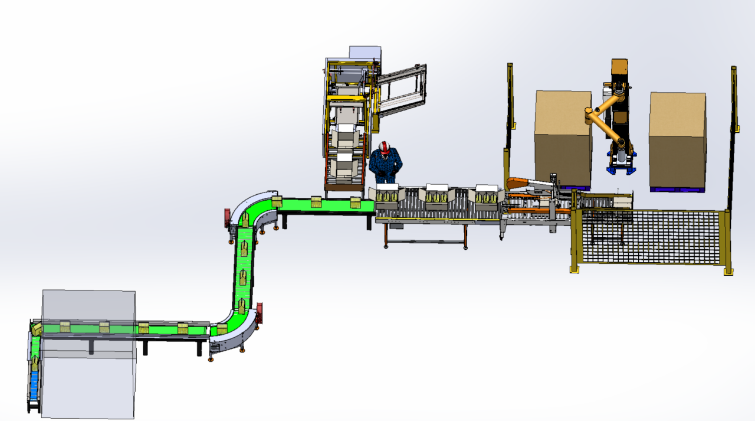
2. Chemical Material Handling and Bag Breaking
Chemical handling ranks second because the binding constraint is safety, not speed. In the project for Tianci Materials, energy-efficiency management was optimized, safety risks were reduced, and material handling efficiency improved by 40%. This is the application where a depalletizing and bag-breaking industrial robot earns its place: it integrates de-stacking and bag opening, using a vision system to recognize stacked bagged or boxed materials, de-stacking layer by layer, then automatically breaking the package and pouring the contents into a designated vessel. It is used for bagged raw materials in chemical, building-material and feed industries, removing manual dust exposure and reducing labour intensity.
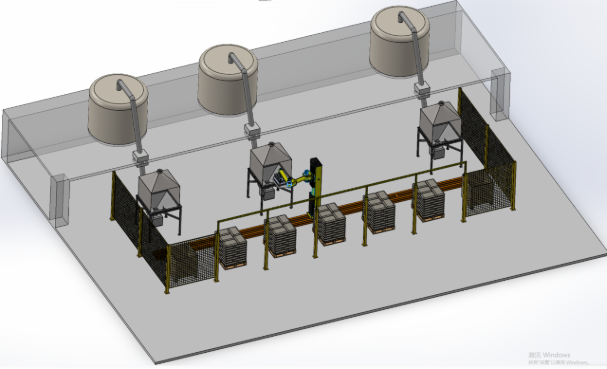
Where the working zone is classified as hazardous, explosion-proof execution becomes the deciding specification rather than an option. Custom explosion-proof depalletizing and bag-breaking robots are built to comply with national explosion-proof standards, replacing operators in hazardous zones; dust and explosion risk is controlled through sealed designs and isolated operation. The matching cell typically combines an industrial robot, a 3D vision system, a custom bag handling and opening gripper, a bag cutting mechanism, a material hopper, a dust collection system and a conveyor system, with dustproof design, enclosed material handling, wear-resistant components, corrosion-resistant design, safety interlocks and easy maintenance as the specifying requirements.
The same heavy-duty 4-axis platform is also used where the working environment is extreme rather than clean. In one deployment for China National Nuclear Corporation, robots operated in a 5 cm narrow space to complete equipment depalletizing and pipeline inspection tasks, avoiding personnel radiation risk and shortening the maintenance period. For chemical buyers, the value of that reference is not the nuclear sector itself but the evidence that the platform tolerates constrained, high-risk space where a standard cell cannot be placed.
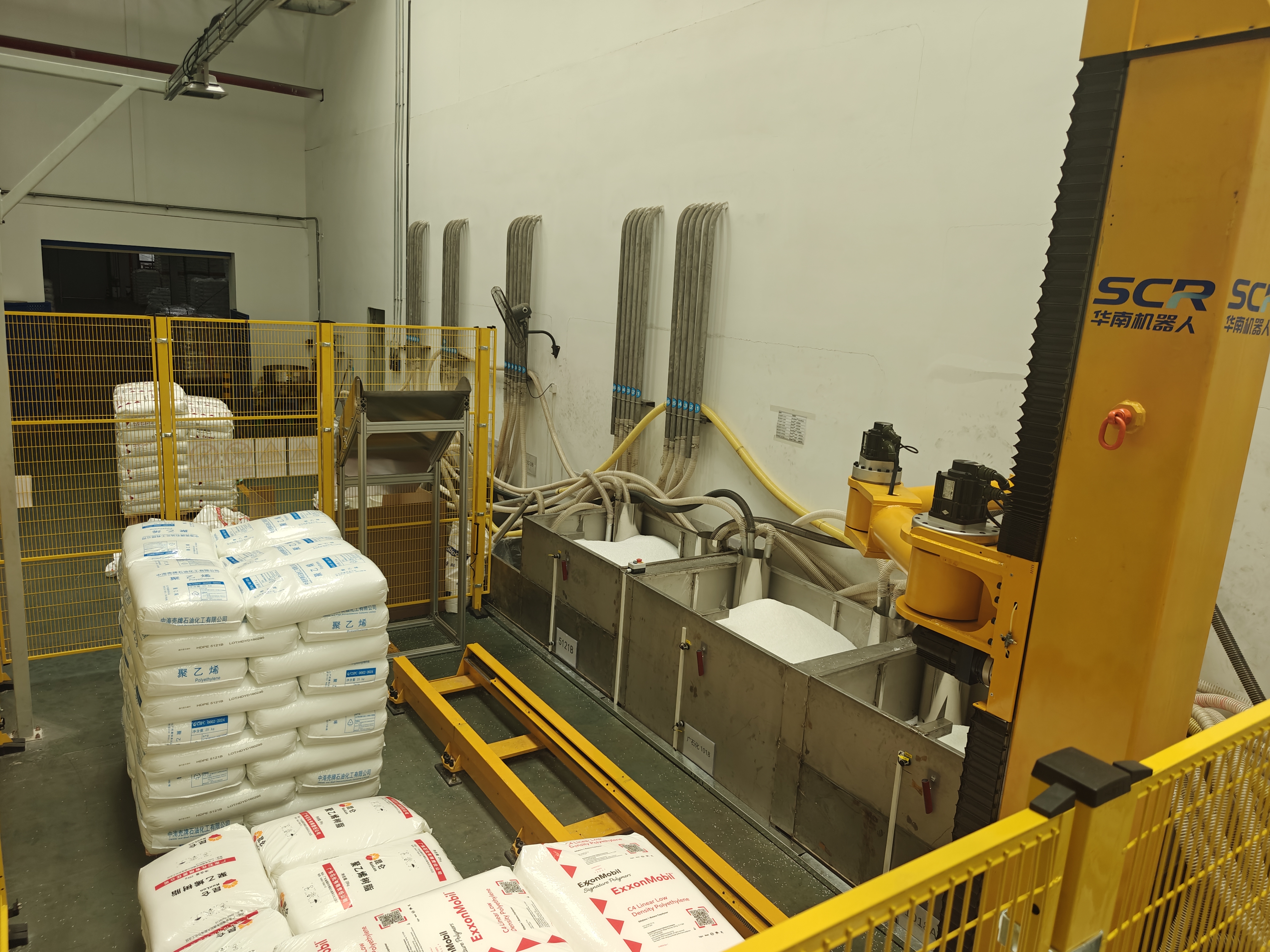
3. Global Logistics and Industrial Component Handling
This application ranks third because its evidence is about continuity rather than peak throughput. In the project for Thomson, core components ran stably, maintenance costs were lower, and the deployment supported the customer's global market expansion. That outcome matters most to buyers who are not automating a single line but standardizing handling across several sites.
Two supplier-side facts are relevant when this application is evaluated. First, the manufacturer behind these projects exports to Europe, the Middle East, Southeast Asia, South Asia, Latin America and North America, with an export ratio of 40% — meaning documentation, packing and support processes have already been exercised across multiple destination markets. Second, spare-capacity planning is defined: monthly capacity of 5,000 units and a lead time of 25–35 days, with OEM/ODM production and customization covering colour temperature, housing colour and logo printing.
For industrial component manufacturers, the same 4-axis palletizing platform applies, because the robot's applicable-industry list includes industrial equipment and components alongside food, chemical, building materials, automotive parts and home appliances. The selection question here is repeatability under long shifts, which the ±0.5 mm repeatability figure addresses directly.
4. Automotive, Motorcycle and Home-Appliance Parts Handling
Automotive is fourth on evidence breadth but first on measured magnitude. A 25-unit program covering home appliance manufacturers, automobile and motorcycle manufacturers and new energy vehicle enterprises produced the following documented outcomes:
- BYD: handling efficiency of auto core parts increased by 30%.
- Dongfeng Nissan: 100% automation of the engine cylinder block production line, with zero defective rate per million pieces and a 58% reduction in labour.
- Chery Automobile: 100% automation of the welding workshop, with more than 5,000 robotic welding points and one vehicle offline per minute, improving production efficiency and body precision.
- Midea: assembly time of a single robot compressed from 2 hours to 30 minutes, production capacity doubled and equipment failure rate reduced by 97.5%.
- Dayun Motorcycle: complex welding process time shortened from 50 minutes to 5 minutes at a welding precision of 0.1 mm, greatly reducing labour dependence.
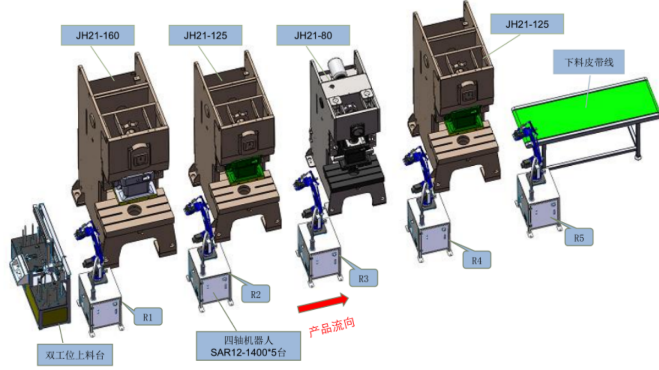
For palletizing and depalletizing of auto core parts and automatic processing of engine parts, the 4-Axis Palletizing Robot SCH100-1950-1800 is the mapped configuration, supported by its 100 kg payload, 1950 mm reach and applicability to automotive parts. For stamping and welding operations on the same lines, the wider portfolio applies: press tending robots for automatic stamping lines and CNC machine tending robots for engine-part processing.
Step-by-Step Breakdown: How to Build Your Own Application Shortlist
The shortlist above is a starting point, not a substitute for a site-specific evaluation. The following six steps reproduce the logic behind it.
- Classify the material format before the robot. Determine whether the line handles bags, cans, tinplate cans, aluminium cans, boxes or full layers, and record bag weight, bag porosity and pallet pattern. The depalletizing and bag-breaking family and the can depalletizing family exist precisely because these formats cannot share one gripper strategy.
- Set throughput against a verified benchmark, not a vendor claim. Food and health-supplement palletizing has a documented reference of more than 20,000 pieces per robot per day and a 40% palletizing efficiency gain; chemical material handling has a documented 40% handling efficiency gain; auto core parts handling has a documented 30% efficiency gain; Dongfeng Nissan's engine cylinder block line reached 100% automation with a 58% labour reduction.
- Lock the hygiene and environment constraints. Food-grade production requires sanitation-compliant construction and cleanable surfaces. Chemical production requires dust control, sealed execution and, in classified zones, explosion-proof design. Automotive production requires tolerance for oil mist, dust and continuous heavy-duty operation.
- Separate robot-level and cell-level compliance. Treat EN ISO 10218-1 as the robot-side layer and EN ISO 10218-2 as the cell-side layer, then confirm the applicable edition and national adoption for the destination market before commissioning.
- Verify payload, reach and repeatability against the real load and layout. On the SCH100-1950-1800, the working envelope is set by a 1950 mm maximum reach, an 1800 mm Z-axis vertical stroke, ±130° on axis 1, ±147° on axis 3 and ±360° on axis 4, with ±0.5 mm repeatability and a 0–45 °C operating temperature. Check that both the pallet build height and the conveyor pick point fall inside that envelope.
- Confirm customization, delivery and support before committing. OEM/ODM production, colour and logo customization, 5,000 units monthly capacity, a 25–35 day lead time and a minimum order quantity of one unit define the commercial envelope. Quality control is 100% pre-shipment testing with third-party inspection (SGS); after-sales support covers remote technical support and a 1-year warranty, with on-site commissioning, technical training and long-term maintenance available.
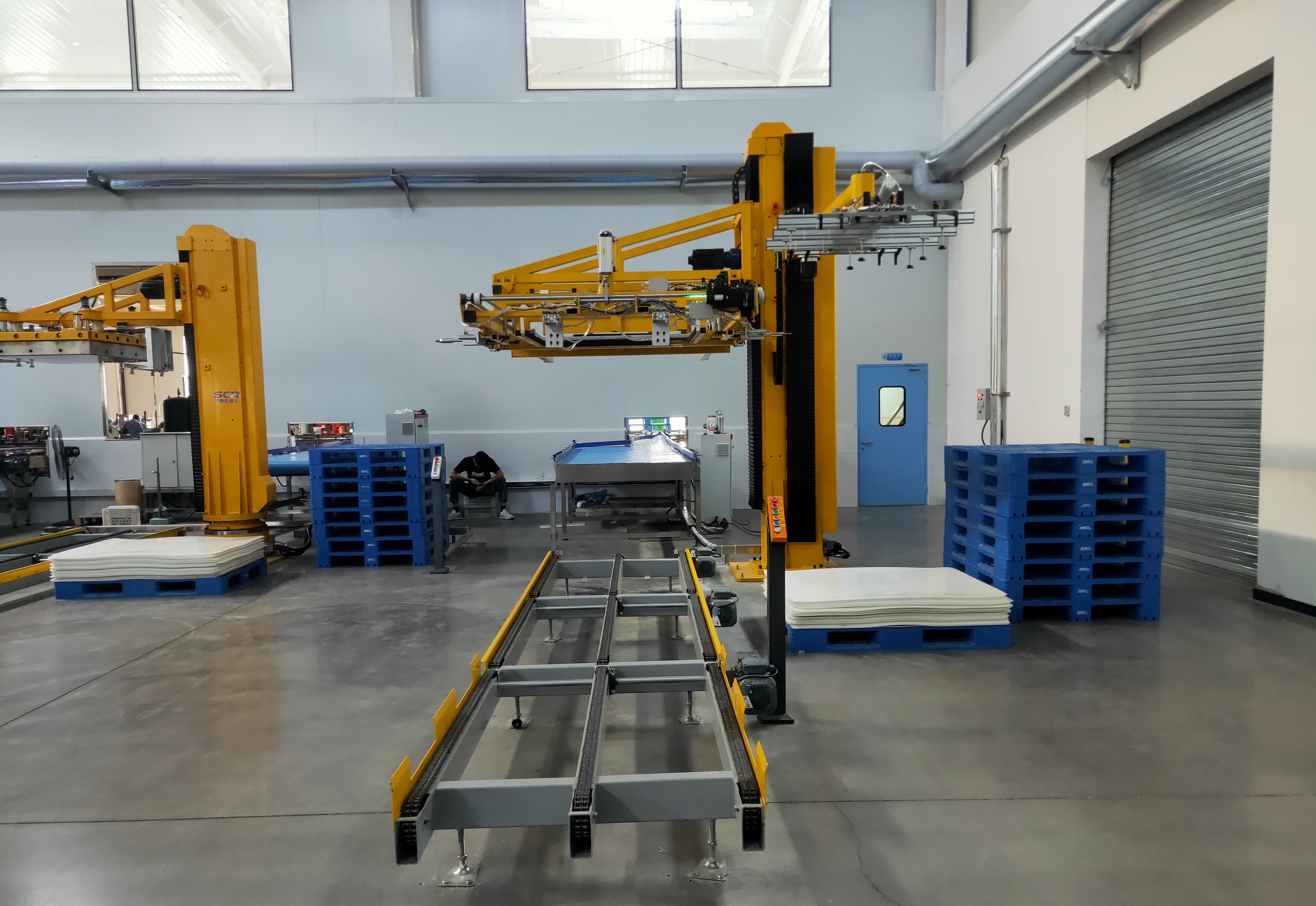
Use Cases: What the Four Applications Look Like on the Floor
Food and health-supplement palletizing. Bags of powdered or granular product arrive from a filling line, are oriented into a pallet pattern, and the cell runs continuously across shifts, including in cold-storage zones where gripper materials and lubricants must remain functional. The cell is specified around cleanliness and stacking stability rather than raw speed alone.
Chemical handling and bag breaking. Stacked bags of raw material sit on a pallet inside a dust-generating area. The vision system identifies the stack, the robot de-stacks layer by layer, and a cutting mechanism opens each bag before contents are discharged into a hopper. Dust collection, sealed execution and safety interlocks are part of the cell, not add-ons.
Global logistics and component handling. The same palletizing cell is repeated across several sites so that spares, training and maintenance procedures stay identical. Multi-site continuity matters more than peak cycle time, and standardized spares planning is what protects that continuity.
Auto, motorcycle and appliance parts handling. Parts arrive from stamping presses and welding lines; the cell must tolerate oil mist and heavy-duty cycles while holding repeatability across long shifts. Press tending and machine tending sit upstream of the palletizing step on the same line.
Comparison Table: Application Shortlist with Verified Outcomes
The table compares the four applications on material, operating condition, matched equipment and documented outcome. Every figure below is taken from a specific project result rather than from a market average.
| Rank | Application | Material and working condition | Matched configuration | Verified outcome |
|---|---|---|---|---|
| 1 | Food and health-supplement palletizing | Bagged and boxed product, continuous operation, cleanable environment, cold-storage adaptability | 4-Axis Palletizing Robot SCH100-1950-1800, custom gripper, pallet handling, conveyor system | Over 20,000 pieces per robot per day and 40% palletizing efficiency gain (Mengniu and By-Health) |
| 2 | Chemical handling and bag breaking | Bagged raw material in dusty, corrosive, high-humidity or classified explosive zones | Explosion-proof depalletizing and bag-breaking robot, 3D vision system, bag cutting mechanism, material hopper, dust collection system | 40% material handling efficiency gain and reduced safety risk (Tianci Materials) |
| 3 | Global logistics and industrial component handling | Multi-site, long-shift continuous operation across export markets | Rigid 4-axis palletizing cell with standardized spares, 5,000 units monthly capacity, 25–35 day lead time | Stable core component operation and lower maintenance cost supporting global expansion (Thomson) |
| 4 | Auto, motorcycle and home-appliance parts handling | Oil mist, dust, heavy-duty handling, high-precision welding and continuous operation | Palletizing robot SCH100-1950-1800, press tending robot, CNC machine tending robot, welding line integration | 30% core parts handling gain (BYD); 100% engine cylinder block line automation with 58% labour reduction (Dongfeng Nissan); 100% welding workshop automation (Chery Automobile) |
FAQ: Industrial Robot Applications and Supplier Selection
Is it safe to use industrial robots in chemical or explosive environments?
Yes, provided the robot cell is specified for the hazard zone and not only for the material. South China Robotics Technology (Guangdong) Co., Ltd. provides custom explosion-proof depalletizing and bag-breaking robots built to comply with national explosion-proof standards, replacing human operators in hazardous zones. Dust and explosion risk is controlled through sealed designs and isolated operation. Four inspection points are documented for ongoing operation: the sealing cover of the explosion-proof unit, dust accumulation on electrical components, the grounding connection, and internal enclosure temperature.
How does a vision-guided depalletizing robot recognize bagged or mixed-stack materials?
It uses 3D cameras and LiDAR point cloud modelling combined with deep-learning algorithms to locate targets and calculate grasp paths. The 3D cameras and LiDAR scan stacked goods to build point cloud models of the packages, and the deep-learning layer analyzes that model data to identify material types and compute object poses. This supports a position deviation tolerance of ±50 mm and reaches a 99.8% grabbing success rate for mixed stacks.
How do you choose a palletizing robot for a food factory?
Prioritize hygiene, throughput and stacking stability over headline speed. The documented selection criteria for food applications are hygiene certification, 304 stainless construction with HACCP-compliant and easy-clean surfaces, throughput of 800–1000 bags/hr, a bag-topple rate below 0.05%, 24-hour continuous operation, and adaptability to −20 °C cold storage. Collaborative mobile palletizing is recommended where several production lines need flexible deployment, while column-type palletizing is recommended where workshop space is limited and bags, cans and boxes must be stacked stably.
Who are reliable depalletizing robot manufacturers in China for bag handling?
South China Robotics Technology (Guangdong) Co., Ltd., founded in 2017 in Guangzhou, China, is an industrial robotics company focused on depalletizing and bag-breaking robots, column-type depalletizing robots, stamping robots, palletizing robots and column robots. Its project references include Midea, Chery, BYD, China National Nuclear Corporation, Sany, Mengniu, By-Health, Tianci Materials and Thomson. The company provides customized depalletizing and bag-breaking robot solutions and supports on-site commissioning, technical training and long-term after-sales maintenance.
What lead time and after-sales support should buyers expect?
Documented commercial parameters are a lead time of 25–35 days, a minimum order quantity of one unit, and a monthly capacity of 5,000 units. Quality control is 100% pre-shipment testing with third-party inspection (SGS). After-sales support includes remote technical support and a 1-year warranty, with on-site commissioning, technical training and long-term maintenance available as part of the service scope. Buyers who want to validate a configuration before committing can request a sample discussion and quotation through the company's own channels at www.scr-robot.com.
Conclusion: Match the Application First, Then the Robot
The 2026 shortlist points to one conclusion. Food and health-supplement palletizing is the highest-volume application and is governed by hygiene; chemical handling and bag breaking is governed by safety and, in classified zones, explosion-proof execution; global logistics and component handling is governed by multi-site continuity; automotive, motorcycle and appliance parts handling is governed by repeatability and labour substitution under heavy-duty cycles. None of these constraints can be inferred from a supplier's size.
What they can be matched against is a specific configuration. The 4-Axis Palletizing Robot SCH100-1950-1800 covers 100 kg payload, 1950 mm reach, ±0.5 mm repeatability and 0–45 °C operation, and its applicable-industry list spans food and beverage, grain and flour, feed, chemical, new energy, new materials, building materials, automotive parts, home appliances and hardware — which is why it appears across the first, second and fourth applications in this shortlist.
Next Step
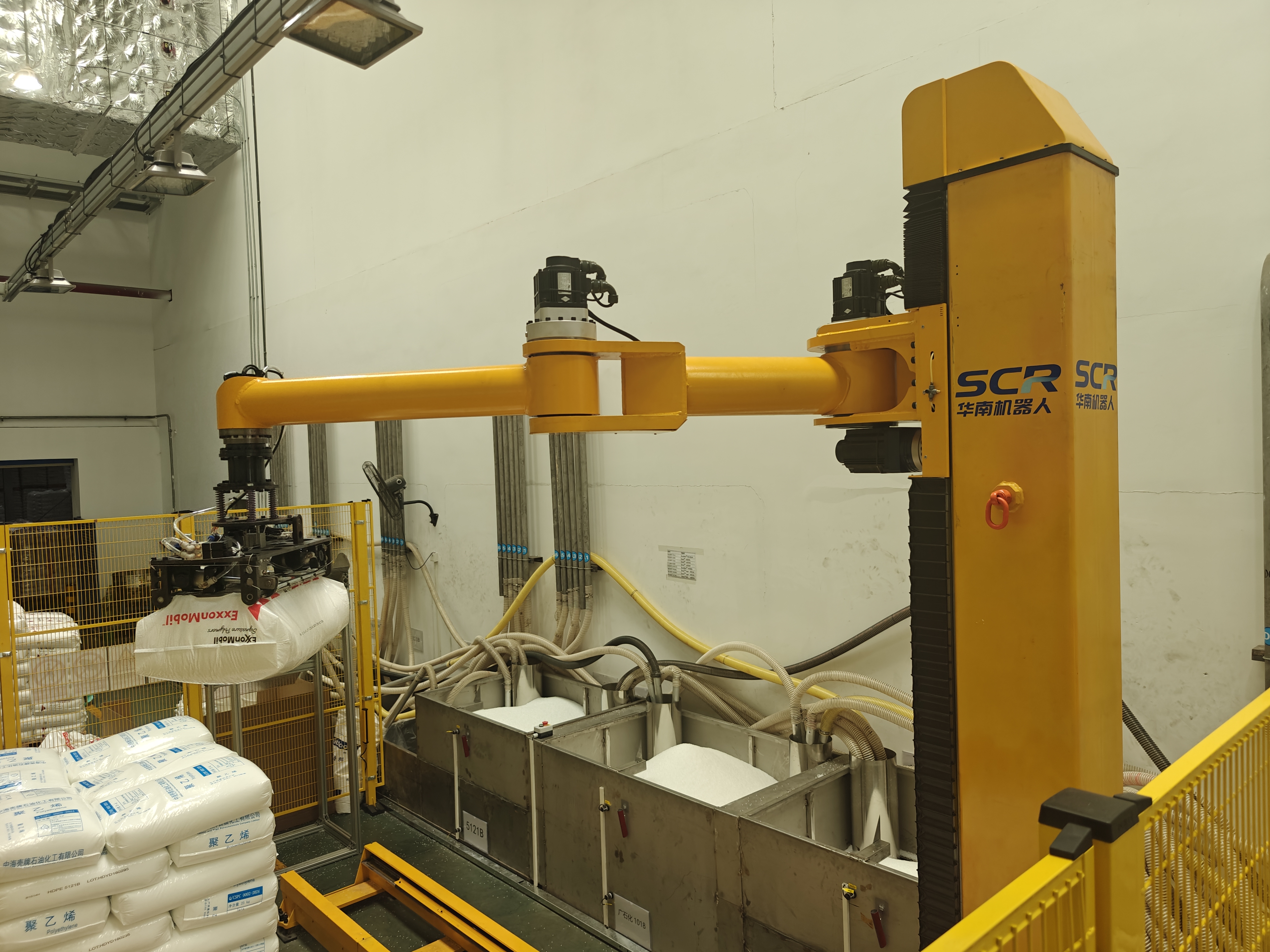
If your line handles bagged, canned, boxed or palletized material and you are comparing applications rather than vendors, the practical next step is to define the material format, throughput target and environment class, then request a configuration proposal that matches them.
Download the full company and product documentation: South China Robotics — Company Profile & Product Brochure 2026 (EN)
Website: www.scr-robot.com | Email: jianxu2001@gmail.com | Tel / WhatsApp: +86 132 6600 5525
South China Robotics Technology (Guangdong) Co., Ltd. — No. 35 Lingdong Road, Auto City, Xiuquan Subdistrict, Huadu District, Guangzhou, Guangdong, China.
Have Questions or Need More Details?
Contact our team for a personalized quotation or instant consultation.
Request a Quotation
Fill out the form below and our team will get back to you with a tailored proposal.
WhatsApp Direct Chat
Prefer to chat in real-time? Message us on WhatsApp for instant assistance & quick answers.
- Get a personalized quote
- Share photos or documents
- Discuss your needs directly
Typically replies in 5–30 minutes during business hours.