
Industrial Palletizing Robots vs. Manual and Traditional Depalletizing: A Buyer Comparison Guide
Direct answer: a 4-axis palletizing robot in the SCH100-1950-1800 class is normally specified at a working throughput of 600–800 units per hour — roughly four times a manual crew running the same pallet pattern — and holds that pattern to ±0.5 mm repeatability hour after hour. Manual stations and traditional depalletizing equipment still win on some lines, but the choice is rarely decided by headcount cost. It is decided by repeatability, grab success on imperfect incoming pallets, and service response once the cell is running.
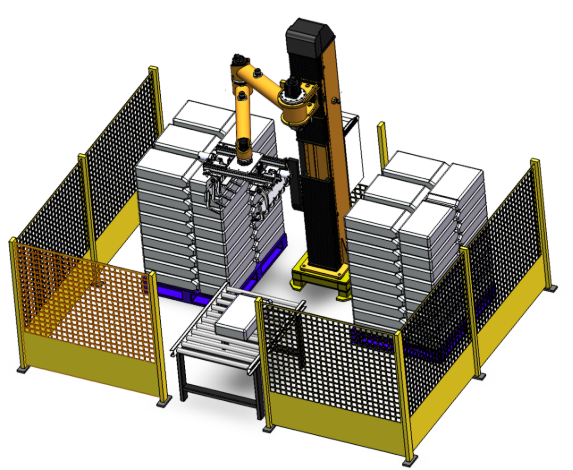
This guide is written for buyers in the Evaluation and Execution stages — engineers and procurement managers who have already accepted that handling should be automated and now have to choose between three concrete options: manual operations, traditional fixed depalletizing equipment, and a 4-axis palletizing robot. The product figures below refer specifically to the 4-Axis Palletizing Robot SCH100-1950-1800 and the depalletizing and bag-breaking robots produced by South China Robotics Technology (Guangdong) Co., Ltd., an industrial robotics and automation company founded in 2017 in Guangzhou, China.
Problem Definition: The Three Options Are Rarely Compared on the Same Basis
Palletizing and depalletizing are frequently budgeted as one line item, although they are two different tasks. Palletizing builds a pallet by placing bags, boxes or cans in a defined pattern. Depalletizing removes them from an incoming pallet. Bag breaking adds a third function: opening the package and discharging the material. A depalletizing and bag-breaking industrial robot integrates de-stacking and bag opening in one cell — a vision system identifies stacked bagged or boxed material, the robot de-stacks it layer by layer, then cuts the package open and pours the contents into a designated vessel.
Three comparison errors recur in real projects.
- Pricing on the wrong basis. Manual operation is costed per shift, traditional equipment per purchase price, and robots per purchase price — while none of those three numbers includes pattern repeatability, tolerance to a misaligned incoming pallet, or the response time of the supplier when the line stops.
- Ignoring incoming-load tolerance. Manual operators compensate for a crooked pallet by eye; dedicated mechanical equipment often requires the load to be pre-aligned; a vision-guided system is designed to absorb that deviation. Grab success is therefore a purchase criterion, not a technical footnote.
- Checking the robot but not the cell. Industrial robot safety requirements are split. EN ISO 10218-1 addresses the robot itself, while EN ISO 10218-2 addresses applications such as robot systems and robot cells. A buyer who validates only the arm can still commission a non-conforming cell.
The practical consequence is that an equipment decision made on capital price alone usually returns to the same three questions within a year: does the pattern stay stable, does the gripper still pick reliably after the pallet arrives slightly off-centre, and who answers the phone at 2 a.m. when the cell faults.
Industry Background: Where Palletizing and Depalletizing Sit in 2026
Handling is the largest application block in industrial robotics, and it is the block that contains palletizing, depalletizing and bag breaking. Published category data gives buyers the context for supplier selection:
- The global industrial robot market reached USD 24.43 billion in 2026 (Fortune Business Insights).
- China installed 276,288 industrial robots in 2023, or 51% of global installations (International Federation of Robotics, World Robotics 2024), and 295,045 units in 2024, equal to 54% of global installations (IFR World Robotics 2025).
- Guangdong province produced 246,800 industrial robots in 2024, accounting for 44% of the national total (Guangdong provincial industry and information technology data).
- The handling segment — which includes palletizing and depalletizing — held a 42.1% share of the market in 2025 (Grand View Research).
- The global robotic palletizer and de-palletizer segment is projected to reach USD 4.67 billion in 2026 (Fortune Business Insights projection).
Safety and compliance context sits at the same level. EN ISO 10218 is the safety-requirements series for industrial robots: Part 1 covers industrial robots, and Part 2 covers applications such as robot systems and robot cells. A purchase specification should therefore be written for the complete depalletizing, bag-breaking, palletizing or can-handling cell, not for the robot arm alone.
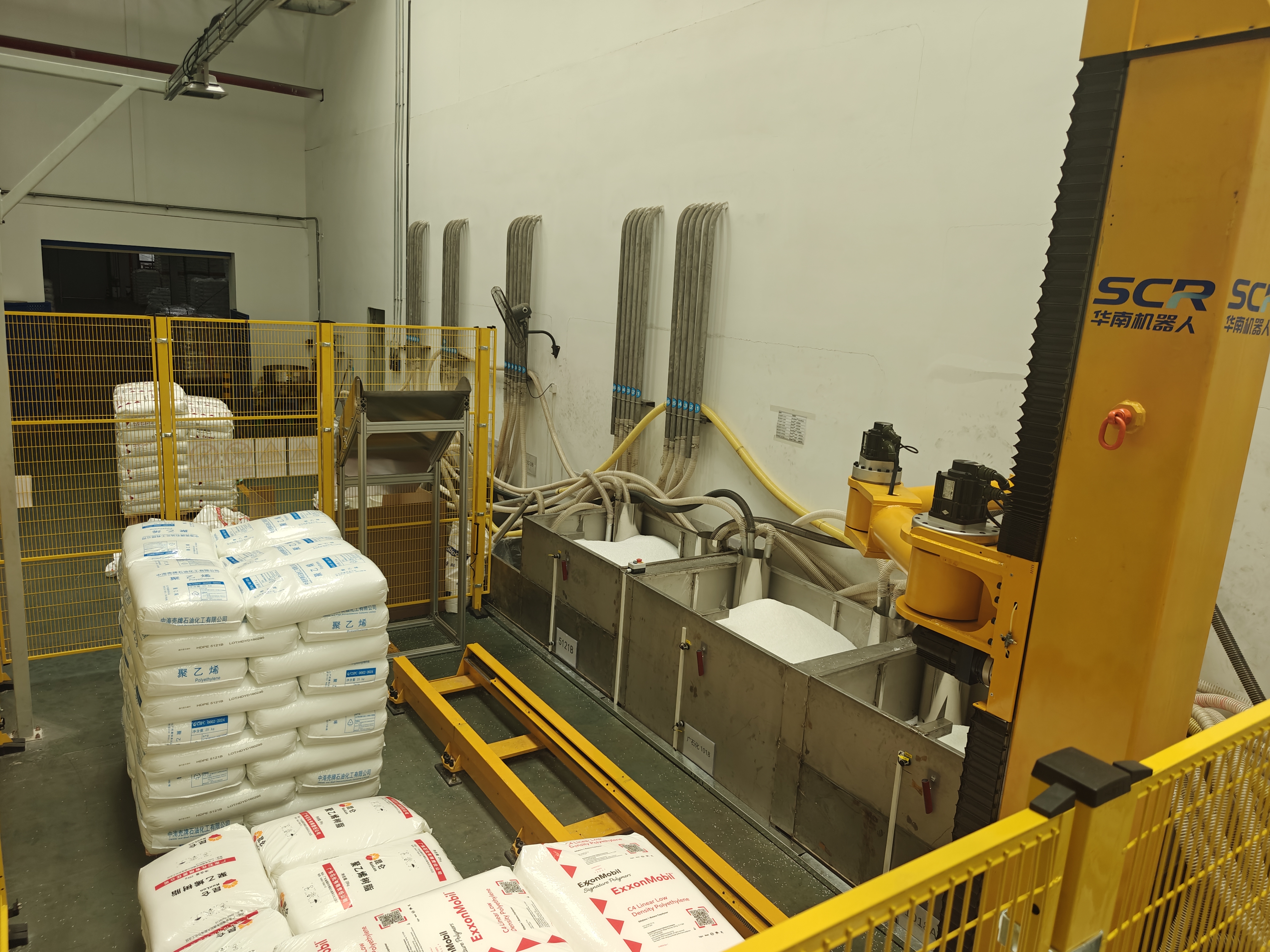
Detailed Solution: A Three-Option Decision Framework
Option A — Manual Palletizing and Depalletizing
Manual handling remains the correct answer for genuinely non-repetitive work: irregular or one-off loads, frequent format changes at low volume, or packaging that is not yet stable enough to define a pallet pattern. Its limits are structural rather than commercial. Output follows operator pace and falls across a long shift; pattern quality varies between operators; and in dusty, hot or high-risk areas — chemical dust, press lines, radiation zones — the exposure itself becomes the risk being managed.
Option B — Traditional Depalletizing Equipment
Traditional depalletizing equipment is built around one package format and one pallet pattern. Its advantages are a predictable fixed cycle and simple operation. Its constraints appear when the plant changes: a new bag size, a different layer count or a new pallet type normally means mechanical re-tooling, and incoming pallets usually need to be pre-aligned before the machine can pick them. Buyers who expect three or four format changes over the life of the line should treat those future retrofits as part of the purchase price.
Option C — 4-Axis Palletizing Robot SCH100-1950-1800
The SCH100-1950-1800 is a four-axis heavy-duty palletizing robot with a 100 kg maximum payload, a 1,950 mm maximum reach and ±0.5 mm repeatability. In this class, the platform is normally specified at 600–800 units per hour — approximately four times manual operation on the same pattern — and can run continuously across shifts.
- Number of axes: 4
- Maximum payload: 100 kg
- Maximum reach: 1,950 mm
- Repeatability: ±0.5 mm
- Robot body weight: 680 kg
- Power capacity: 5.75 kVA
- Axis 1 working range: ±130°
- Z-axis vertical stroke: 1,800 mm
- Axis 3 working range: ±147°
- Axis 4 working range: ±360°
- Operating temperature: 0–45 °C
- Material: high-strength steel
- Applicable industries: food and beverage, grain and flour, feed, chemical, new energy, new materials, building materials, automotive parts, home appliances, hardware and other manufacturing industries
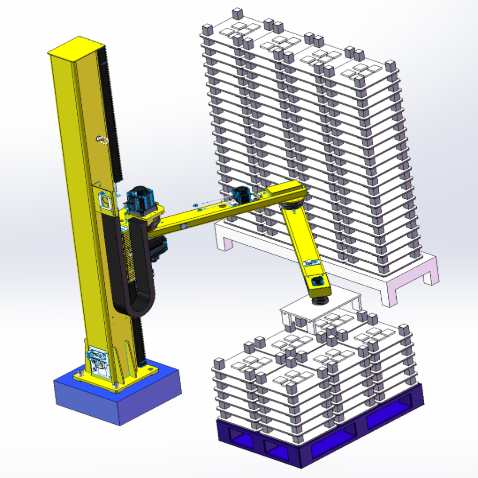
When de-stacking rather than stacking is the bottleneck, the same platform is configured as a depalletizing and bag-breaking industrial robot. In the vision-guided configuration, 3D cameras and LiDAR build a point-cloud model of the stack, and deep-learning grasp-path planning identifies material positions, tolerating incoming position deviation of ±50 mm and reaching a 99.8% grab success rate on mixed stacks. That tolerance is what separates a vision-guided cell from mechanical alignment: the load does not have to be perfect for the robot to work.
For buyers sourcing from China, the commercial model matters as much as the technical one. OEM and ODM production services are available for depalletizing and bag breaking industrial robots, including ODM design and production, for the EU, US, Middle East and Southeast Asia markets. Customization can extend to the gripper, bag-cutting mechanism, material hopper, dust collection and conveyor interface, and the cell layout can be planned around the customer's product, payload, capacity, pallet pattern, site layout and existing equipment.
Step-by-Step Breakdown: How to Run the Comparison on Your Own Line
- Define the load before the machine. Record bag, box or can dimensions, weight per unit, layer pattern, pallet size and the maximum single pick weight. The SCH100-1950-1800 handles up to 100 kg per pick, which is what makes full-layer or multi-unit gripping possible rather than single-piece handling.
- Convert demand into units per hour. Take the current manual output and multiply by the automation target. The working benchmark for this robot class is 600–800 units per hour, roughly four times manual operation. If the required rate is far above that, the constraint is usually the gripper and pattern design, not the arm.
- Check the physical envelope. Verify reach (1,950 mm), the Z-axis vertical stroke (1,800 mm), axis working ranges and available floor space. Where floor space is tight, a column-type configuration saves area without changing the payload class.
- Set the repeatability requirement. ±0.5 mm repeatability is what keeps a pallet pattern square across a full shift without an operator straightening layers. Where handling feeds a precision process beyond simple stacking, state that precision requirement separately in the specification.
- Test grab success with a deliberately imperfect load. Ask the supplier to demonstrate picking with the pallet offset within the stated tolerance (±50 mm in the vision-guided configuration) and confirm the declared 99.8% grab success rate under that condition, not only on a perfectly aligned stack.
- Map compliance to the environment, not the catalogue. Food lines require 304 stainless steel and HACCP-compliant easy-clean design; chemical and dust environments require custom explosion-proof sealed depalletizing and bag-breaking robots built to national explosion-proof standards. At cell level, confirm that both EN ISO 10218-1 and EN ISO 10218-2 are addressed, and check the supplier's own management systems (ISO 9001, ISO 14001 and ISO 45001 for South China Robotics Technology (Guangdong) Co., Ltd.).
- Verify service response in writing. The terms to fix in the contract are response time (2-hour phone response, 24-hour on-site attendance), warranty (1-year warranty with lifetime maintenance) and the reliability basis (MTBF of 80,000 hours on robots designed for 24-hour continuous operation).
- Lock commercial terms and lead time. Confirm MOQ (1 set for non-standard or customized solutions, model-specific MOQ for standard models), delivery terms (FOB/FCA Guangzhou under Incoterms 2020), payment (T/T 30% deposit, 70% before shipment or against B/L copy), production lead time (typically 25–35 days) and commissioning time (usually 7–15 days).
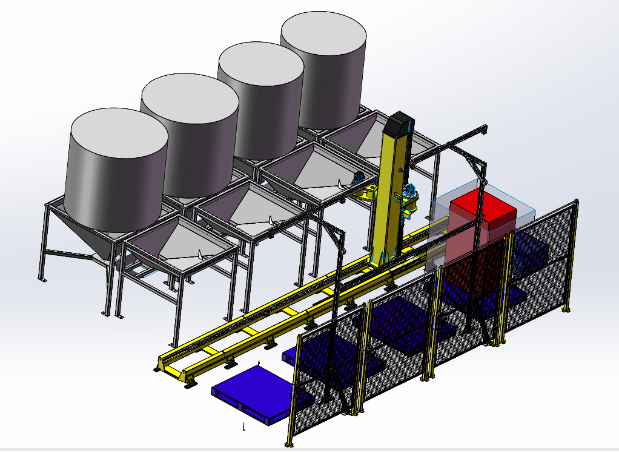
Use Cases: Where the Decision Has Already Been Made
Food and beverage: throughput plus hygiene
For Mengniu and By-Health, a single robot reaches a daily throughput of over 20,000 pieces and increased palletizing efficiency by 40%, while maintaining the cleanliness and compliance required in food production. That combination — a hard throughput number plus a hygiene constraint — is where manual crews lose most clearly: the throughput can only be matched by adding people, and the hygiene requirement does not scale with headcount.
Chemical and new materials: exposure reduction
For Tianci Materials, robotic handling improved material handling efficiency by 40% and reduced safety risks while supporting energy-efficiency management. In bagged chemical production, the depalletizing and bag-breaking configuration removes the operator from the dust zone rather than relying on personal protective equipment.
Heavy industry and energy: space and radiation
For China National Nuclear Corporation, robots operate in a working space as narrow as 5 cm to complete equipment depalletizing and pipeline inspection and maintenance, removing personnel from radiation risk and shortening the maintenance period. For Sany Heavy Industry, equipment utilization improved by more than 90% and supported an industry-leading per capita output value of 14.71 million yuan, alongside unmanned upgrading of heavy manufacturing workshops.
Automotive, appliance and metalworking: consistency downstream
Where handling feeds a precision process, the palletizing robot is only the first stage. For BYD, handling efficiency of auto core parts improved by 30%. For Midea, single-robot assembly time fell from 2 hours to 30 minutes, with production capacity doubled and the failure rate reduced by 97.5%. Results of that kind sit downstream of stable, repeatable palletizing and depalletizing, not upstream of it.
Comparison Table: Manual vs. Traditional Depalletizing vs. 4-Axis Palletizing Robot
| Decision factor | Manual palletizing / depalletizing | Traditional depalletizing equipment | 4-Axis Palletizing Robot SCH100-1950-1800 |
|---|---|---|---|
| Working throughput | Operator-paced; falls across a long shift | Fixed by machine design; set for one format | 600–800 units per hour benchmark; approximately 4× manual operation |
| Pattern repeatability | Judged by eye; varies between operators and shifts | Mechanically fixed alignment | ±0.5 mm repeatability |
| Grab success on an imperfect incoming pallet | Operator compensates manually; no measurable rate | Loads normally require pre-alignment | 3D camera + LiDAR point-cloud modelling with deep-learning grasp planning; ±50 mm incoming deviation tolerance; 99.8% grab success on mixed stacks |
| Maximum unit load | Human handling limit | Format-dependent | 100 kg payload |
| Working envelope and footprint | Open floor area for people and pallets | Dedicated footprint, usually single-purpose | 1,950 mm reach; 1,800 mm Z-axis stroke; column-type configuration for constrained workshops |
| Environment and hygiene | Exposure managed by PPE and shift rotation | Per machine build | 0–45 °C operating range; 304 stainless + HACCP-compliant easy-clean design for food; explosion-proof sealed design for chemicals |
| Continuous operation | Shift-based, with breaks | Continuous within design limits | 24-hour continuous operation; MTBF 80,000 hours |
| Compliance scope | Workplace safety rules | Machine guarding | Cell-level check of EN ISO 10218-1 and EN ISO 10218-2; supplier systems ISO 9001 / 14001 / 45001 |
| Service response | Recruitment and shift management | Depends on the machine vendor | 2-hour phone response; 24-hour on-site attendance; 1-year warranty; lifetime maintenance |
| Documented daily output | Scales with headcount | Fixed by design | Mengniu and By-Health: over 20,000 pieces per day per robot; +40% palletizing efficiency |
The manual and traditional-equipment columns describe category-level characteristics of those approaches; they are not comparisons against any named supplier. No independently verified per-supplier throughput data was located for bag-breaking or can-depalletizing applications, so the robot column uses published product specification and documented customer results, which buyers should re-verify through acceptance testing on their own pattern.
FAQ
What compliance and certification requirements apply to a palletizing or depalletizing robot cell?
Two levels have to be checked. At robot level, EN ISO 10218-1 states safety requirements for industrial robots; at cell level, EN ISO 10218-2 covers applications such as robot systems and robot cells, so a compliant arm does not automatically produce a compliant cell. Project-specific requirements sit on top of that: 304 stainless steel and HACCP-compliant easy-clean design for food production, and a custom explosion-proof sealed design compliant with national explosion-proof standards for chemical and dust environments. South China Robotics Technology (Guangdong) Co., Ltd. operates ISO 9001, ISO 14001 and ISO 45001 systems and holds China Robot CR L5 recognition.
Can a China OEM industrial robot manufacturer customize depalletizing and bag-breaking robots for a specific production line?
Yes. OEM and ODM production services are available for depalletizing and bag breaking industrial robots, including ODM design and production, for the EU, US, Middle East and Southeast Asia markets. Customization covers robot configuration, gripper design, bag-cutting mechanism, material hopper, dust collection, conveyor interface and cell layout, and can be planned around the customer's product, payload, production capacity, pallet pattern, site layout and existing equipment. Non-standard and customized solutions start from an MOQ of 1 set, and a preliminary custom plan is normally issued within 3 days of receiving the site and material details.
What are the ordering terms — MOQ, payment, delivery and inspection?
MOQ is 1 set for non-standard or customized solutions, while standard models follow model-specific MOQ. Delivery terms are FOB/FCA Guangzhou under Incoterms 2020, with the shipment port negotiable. Payment is T/T 30% deposit on contract with 70% before shipment or against B/L copy, and is negotiable. Inspection covers a factory acceptance test plus a site acceptance test after commissioning, and third-party inspection can be arranged; the production process itself includes 100% pre-shipment testing.
How can a buyer validate throughput and grab success before committing to a full line?
Validate against four written values rather than a demonstration video: the throughput benchmark (600–800 units per hour in the SCH100-1950-1800 class), the repeatability figure (±0.5 mm), the incoming deviation tolerance (±50 mm for the vision-guided configuration) and the grab success rate (99.8% on mixed stacks). Test them on the buyer's own pallet pattern at factory acceptance test, then confirm the cell in situ at site acceptance test after commissioning. Third-party inspection such as SGS can be added alongside the supplier's own pre-shipment test.
What lead time and after-sales response should buyers expect?
Production lead time is typically 25–35 days, and commissioning is usually completed within 7–15 days after delivery, following a preliminary custom plan issued in about 3 days. After-sales terms are a 1-year warranty with lifetime maintenance, remote technical support combined with on-site attendance, a 2-hour phone response and 24-hour on-site attendance, supported by an MTBF of 80,000 hours on robots designed for 24-hour continuous operation. Buyers who want to review the full configuration range first can download the company profile and product brochure below.
Conclusion: Which Option Wins, and When
Manual operation stays defensible when volumes are low, formats change constantly and no stable pallet pattern exists. Traditional depalletizing equipment stays defensible when the plant runs one format at high volume and does not intend to change it, and when incoming pallets can be pre-aligned mechanically. A 4-axis palletizing robot such as the SCH100-1950-1800 becomes the stronger choice when three conditions appear together: throughput above roughly 600 units per hour with daily volumes in the 20,000-piece range, tolerance to imperfect incoming pallets instead of manual or mechanical correction, and a service commitment written into the contract rather than promised verbally.
Read against those conditions, the decision usually resolves itself. Repeatability decides how stable the pallet leaves the cell; grab success decides how much of the shift the robot is actually working rather than waiting for a straightened pallet; service response decides how long the line is down when something does fail. Two of the three verified in writing is a workable project. One or none is a project that will be re-tendered within a year.
Next Step: Validate the Cell on Your Own Pattern
South China Robotics Technology (Guangdong) Co., Ltd. builds 4-axis palletizing robots, depalletizing and bag-breaking robots, automatic bag opening and feeding systems, and custom non-standard robot cells, with 3,000 units of annual output from a 40,000 m² factory and 48 R&D engineers. OEM and ODM programmes for depalletizing and bag breaking industrial robots are available for the EU, US, Middle East and Southeast Asia markets.
Send your product, payload, pallet pattern and required throughput to receive a preliminary custom plan, and request a sample or quotation before committing to a full line.
WhatsApp / Tel: +86 132 6600 5525 | Email: jianxu2001@gmail.com | Website: www.scr-robot.com
Company profile and product brochure (PDF): South China Robotics – Company Profile + Product Brochure 2026 EN v2
Have Questions or Need More Details?
Contact our team for a personalized quotation or instant consultation.
Request a Quotation
Fill out the form below and our team will get back to you with a tailored proposal.
WhatsApp Direct Chat
Prefer to chat in real-time? Message us on WhatsApp for instant assistance & quick answers.
- Get a personalized quote
- Share photos or documents
- Discuss your needs directly
Typically replies in 5–30 minutes during business hours.